
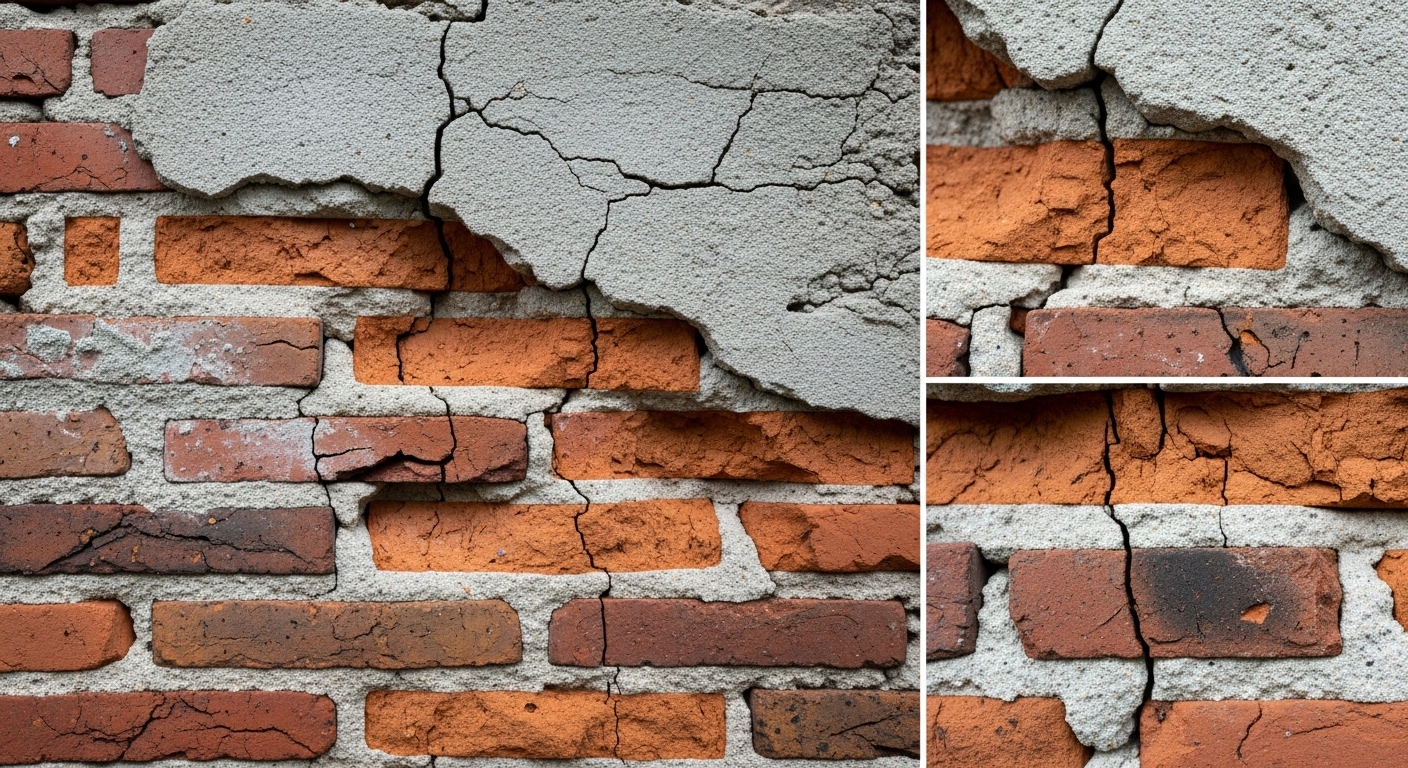
You bought the old brick house because you loved it. The character. The thick walls. The way it’s just… solid in a way new construction never quite feels. And now there’s some cracking or crumbling mortar, and someone—a contractor, a neighbour, maybe a YouTube video—told you to go to the hardware store and grab a bag of mortar mix.
Please don’t.
I know that sounds dramatic. But this is one of those situations where the “quick fix” turns into a $20,000 problem. And honestly, I’ve seen it happen more times than I’d like to count.
If you own a historic brick home in Ohio—especially anything built before the mid-20th century—understanding the difference between old and new mortar isn’t just a nerdy masonry thing. It’s genuinely important for protecting what is probably your biggest investment.
Here are the specific reasons why modern mortar and historic brick are a genuinely bad combination, plus what you should actually do instead. And if you want to talk through your specific situation, the team at K&K Construction specializes in historic masonry restoration in Ohio and is always happy to take a look.
First, a Quick Bit of Background (Bear With Me)
Before the 20th century, most mortar was made with natural hydraulic lime or just regular lime putty. It was soft, flexible, and relatively weak—intentionally so. Modern Portland cement mortars, which became dominant after the 1920s, are a completely different material. They’re much harder, much stronger, and much less permeable.
Here’s the thing: that doesn’t make Portland cement better for old buildings. It actually makes it worse. Old brick was designed to work with soft mortar. That soft mortar was the “sacrificial” layer—meant to absorb movement, moisture, and stress so the bricks themselves didn’t have to.
When you swap out that soft mortar for something harder, the physics of the wall change entirely. And not in a good way.
6 Reasons You Should Never Use Modern Mortar on Historic Brick
1. It Traps Moisture Inside the Wall
Old brick walls breathe. Seriously—moisture moves in and out of the wall constantly, and that’s by design. Lime mortar is permeable, which means water that gets into the wall can also get back out.
Modern Portland cement mortar acts more like a seal. It’s dense and relatively impermeable, so moisture that gets into the wall behind that new mortar has nowhere to go. Over time, that trapped moisture causes efflorescence (those white chalky stains), interior dampness, and eventually, serious structural deterioration.
Think about it this way: you’re essentially wrapping the inside of your wall in plastic wrap. Everything that gets in there just… sits.
Quick tip: If you’re already seeing white staining or damp interior walls, this might already be happening. It’s worth getting someone out to take a look before it gets worse.
2. It Forces Stress Onto the Bricks Themselves
Historic brick is soft. That’s not a flaw—it’s a feature. Soft brick is more porous and better able to absorb minor movements in any structure: settling, thermal expansion and contraction, and slight vibration from traffic or wind.
When you fill the joints with hard modern mortar, you’ve removed the flexible layer that was doing all that work. Now when the wall moves—and it always moves a little—the stress has to go somewhere. And it goes into the brick.
The result is spalling: bricks start to flake, crack, and crumble from the surface inward. Once that starts, it’s hard to stop, and replacing historic brick is expensive and often impossible to match.
3. Ohio’s Freeze-Thaw Cycles Make It Much Worse
Ohio winters are brutal on masonry. We get these repeated cycles where temperatures dip below freezing, thaw out, then freeze again. Every time water freezes inside a wall, it expands with significant force.
With lime mortar, those freeze-thaw stresses are spread out across the softer mortar joints. With Portland cement mortar trapping moisture and providing rigidity, those expansion forces concentrate—and the weakest thing in that system, the historic brick, absorbs the impact.
I’ve seen century-old walls that survived everything Ohio could throw at them for 100 years start deteriorating rapidly within a decade of a bad repointing job. The timing isn’t a coincidence.
Quick tip: Repointing before winter is smart. But doing it with the wrong mortar can leave you worse off than if you’d waited.
4. Modern Mortar Is Nearly Impossible to Remove Without Damage
Here’s where things get really frustrating. Let’s say the damage is already done—maybe a previous owner or contractor used Portland cement, and now you’re dealing with the consequences.
Removing modern mortar from old brick is a nightmare. It’s often harder than the brick itself, so any aggressive removal method (grinding, chiseling) risks damaging the brick face. You can do it, but it takes a highly skilled mason working very carefully, and it’s time-consuming and expensive.
Compare that to lime mortar, which is designed to be softer than the brick so it can be replaced periodically without harm. The whole system was designed with maintenance in mind.
The historic masonry restoration specialists at K&K Construction deal with this problem regularly—carefully removing incompatible mortar without causing additional damage to the brick. It’s delicate work, and it matters.
5. It Can Void Historic Preservation Protections (and Grants)
If your home is on the National Register of Historic Places, in a local historic district, or if you’re planning to apply for any state or federal preservation grants, using inappropriate materials is a serious problem.
The Secretary of the Interior’s Standards for the Treatment of Historic Properties—which govern most preservation work in the U.S.—are pretty explicit: repairs should use materials that are compatible with the original, not harder or more impermeable. Portland cement mortar on old brick typically doesn’t meet that standard.
Using the wrong mortar can disqualify you from grants, create compliance issues if you’re in a historic district, and complicate future restoration funding. And honestly, even if you’re not in a designated district, you’re making decisions about a piece of Ohio history. That matters.
6. It Changes How the Wall Looks—Usually Not for the Better
This one’s a bit more subjective, but worth saying. Modern mortar often looks out of place on old brick. The color, the texture, the joint profile—it’s hard to match what was there originally, and the visual mismatch can be jarring.
More than that, if Portland cement is applied over old joints without full removal, you end up with “cat facing” or “smear pointing”—mortar smeared across the face of the brick—which is both aesthetically terrible and functionally harmful because it creates new paths for water infiltration.
Good repointing is almost invisible. You shouldn’t really notice it—the wall just looks solid and right. Bad repointing, especially with the wrong material, tends to announce itself.
Lime Mortar vs. Portland Cement Mortar: A Quick Comparison
Here’s a simple way to think about how these two materials differ when used on historic brick:
- Flexibility: Lime mortar is soft and flexible; Portland cement is rigid and hard
- Permeability: Lime mortar allows moisture to pass through; Portland cement traps it
- Hardness: Lime mortar is intentionally softer than the brick; Portland cement is often harder
- Removal: Lime mortar can be removed carefully without damaging brick; Portland cement removal risks brick damage
- Historic compatibility: Lime mortar matches pre-20th-century construction; Portland cement is a modern material
- Long-term outcome: Lime mortar protects the brick over decades; Portland cement can cause deterioration within years
Key Takeaways
- Historic Ohio brick was built to work with soft, flexible lime mortar—not hard Portland cement
- Modern mortar traps moisture, concentrates stress, and accelerates deterioration in old masonry
- Ohio’s freeze-thaw cycles dramatically amplify the damage caused by incompatible mortar
- Once Portland cement is applied, removal is difficult and can cause additional damage
- If your home has historic status or you’re pursuing preservation funding, material compatibility isn’t optional
- The right fix is repointing with a mortar that matches the original—typically a lime-based mix appropriate to the brick and era
So What Should You Actually Do?
If you’ve got deteriorating mortar on a historic brick home, the answer isn’t to grab whatever’s at the hardware store. The answer is to find someone who actually understands historic masonry—and to use a mortar that’s appropriate for the age and type of your brick.
That usually means a lime-based mortar, custom mixed to be slightly softer than the brick. In some cases, it might mean a natural hydraulic lime. The right mix depends on your specific building, and getting that right is part of what a good historic mason does.
It’s also worth having an experienced eye look at the whole wall before any work starts. Sometimes what looks like a mortar problem is actually something else—or the mortar issue is a symptom of a bigger moisture or drainage problem that needs to be addressed first.
The team at K&K Construction offers historic masonry restoration in Canton and throughout Ohio. If you’ve got an old brick home and you’re not sure what you’re looking at—or if someone has already used the wrong mortar and you need help figuring out the damage—reach out. This is exactly what they do. Your house survived over a century. With the right care, it’ll survive another one