
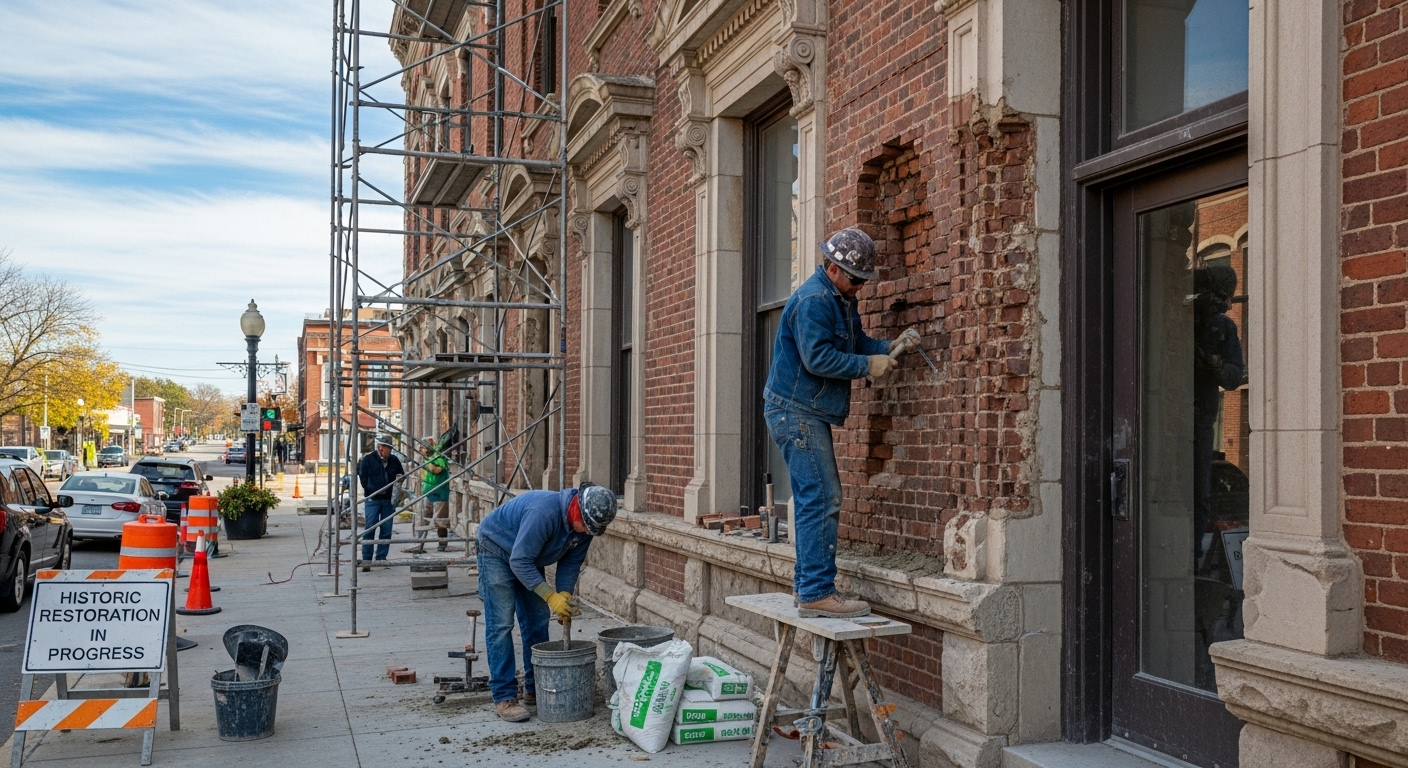
Canton, Ohio, is home to many historic buildings that showcase the city’s rich history and architectural beauty. As these buildings age, however, they often require specialised care to maintain their structural integrity and aesthetic appeal. One of the most important aspects of preserving these buildings is the restoration of their historic masonry.
At K and K Construction, we specialise in historic masonry restoration, offering expert services to restore, repair, and maintain the stone, brick, and mortar that make up some of Canton’s most iconic structures. In this blog, we’ll explore the significance of masonry restoration, the common problems that affect historic buildings, and how we can help you preserve the charm and integrity of your property.
What is Historic Masonry Restoration?
Masonry restoration refers to the process of repairing and maintaining brick, stone, and other masonry materials that have deteriorated over time. The goal of historic masonry restoration is to preserve a building’s original appearance and functionality, extend its lifespan, and ensure it meets modern safety standards.
Historic masonry restoration often involves carefully cleaning, repairing, and replacing damaged masonry components. Unlike regular repairs, historic masonry restoration requires a high level of expertise to ensure that the work respects the original craftsmanship and design.
Why is Historic Masonry Restoration Important?
Masonry is one of the most durable materials used in construction, and many of the buildings in Canton’s historic districts are made from brick, stone, or concrete. Over time, however, these materials can experience wear and tear due to exposure to the elements, pollution, and natural aging.
Restoring historic masonry is important for several reasons:
- Preserving Historical Value: Many of Canton’s historic buildings have cultural, architectural, or historical significance. Preserving the original masonry is essential for maintaining the building’s heritage and the historical character of the area.
- Structural Integrity: Cracked or deteriorated masonry can compromise a building’s structural integrity. Proper restoration ensures that the building remains safe and stable for future generations.
- Enhancing Curb Appeal: Masonry restoration can dramatically improve a building’s appearance, increasing its value and making it more appealing to potential buyers or tenants.
- Preventing Further Damage: Addressing masonry issues early can prevent more severe, costly damage down the line. Regular maintenance can extend a building’s lifespan by addressing problems before they worsen.
Common Problems with Historic Masonry
Historic buildings often face specific masonry challenges that require specialised restoration techniques. Some of the most common issues include:
1. Cracking and Spalling
Over time, masonry can crack due to natural settling, temperature fluctuations, and moisture infiltration. In many historic buildings, this can cause the stone or brick to break apart (spall), exposing the underlying material to further deterioration.
2. Moisture Damage
Masonry is highly porous, which means it can absorb water over time. When water seeps into the mortar joints, it can weaken the masonry, cause rusting in metal supports, and promote the growth of mould or mildew.
3. Mortar Deterioration
The mortar between bricks or stones can degrade over time due to exposure to moisture, temperature extremes, and chemical reactions. This leads to weak or crumbling mortar joints that can compromise the building’s stability.
4. Efflorescence
Efflorescence is a white, powdery substance that appears on masonry surfaces when water evaporates, leaving behind mineral salts. While not immediately harmful, efflorescence can be a sign of moisture intrusion that can damage masonry over time.
5. Structural Shifting
As buildings settle over time, the masonry can shift or become misaligned. This can cause uneven walls, structural stress, and damage to the building’s integrity.
The Historic Masonry Restoration Process
Restoring historic masonry requires a detailed, step-by-step approach to ensure the work is done carefully and correctly. At K and K Construction, we follow a proven process to restore your historic masonry:
1. Assessment and Evaluation
The first step in any masonry restoration project is to thoroughly assess the condition of the building’s masonry. We examine the type of stone or brick, the mortar joints, and any signs of damage, such as cracks, water stains, or missing materials. This evaluation helps us determine the extent of the restoration work needed.
2. Cleaning and Surface Preparation
We begin the restoration process by carefully cleaning the masonry surface to remove dirt, debris, and stains. We use specialized cleaning techniques, such as soft washing or chemical cleaning, to avoid damaging the masonry. In some cases, we may need to remove old paint or coatings to reveal the underlying material.
3. Repointing Mortar Joints
Repointing is the process of removing old, deteriorated mortar and replacing it with fresh mortar. This is essential for maintaining the integrity of the masonry structure. We take great care in selecting the right mortar mix to match the original materials and ensure the longevity of the repair.
4. Repairing or Replacing Damaged Masonry
In cases where bricks or stones are severely damaged, we can replace them with matching materials. We carefully source bricks or stones that match the original materials as closely as possible to maintain the historical accuracy of the building.
5. Waterproofing and Sealing
After the masonry has been restored, we apply waterproofing and sealing treatments to protect the building from future moisture damage. This helps prevent water absorption and protects the masonry from the elements.
6. Final Inspection
Once the restoration work is complete, we conduct a final inspection to ensure everything has been properly restored and sealed. We also check for any remaining issues that need to be addressed before the project is finished.
Benefits of Professional Historic Masonry Restoration
While DIY restoration may seem appealing, working with a professional team like K and K Construction offers numerous benefits:
- Expert Knowledge: Our team has the experience and expertise to handle the complexities of historic masonry restoration. We understand the materials, techniques, and preservation standards required to properly restore historic buildings.
- Quality Workmanship: We are committed to delivering high-quality craftsmanship, ensuring every aspect of the restoration meets the highest standards. Our work not only restores the building’s beauty but also enhances its durability and safety.
- Preservation of Historical Accuracy: Our team is dedicated to maintaining the building’s historical integrity. We take great care in matching original materials and techniques to ensure the restoration is faithful to the building’s history.
- Cost-Effective Solutions: By addressing masonry issues early, we can prevent further damage and more expensive repairs down the road. Regular maintenance and restoration can also extend the building’s lifespan.
When to Consider Historic Masonry Restoration
Historic masonry restoration is a long-term investment that requires careful planning. You should consider masonry restoration if:
- Your building is experiencing visible cracks, water damage, or efflorescence.
- You own a historically significant property that requires preservation.
- You want to maintain or improve the structural integrity and aesthetic appeal of a historic building.
- You plan to sell or lease a historic property and want to increase its value.
Conclusion: Trust K and K Construction for Historic Masonry Restoration
If you own a historic property in Canton or the surrounding areas and are in need of masonry restoration, K and K Construction is here to help. Our team specialises in historic masonry restoration and is committed to preserving the charm, beauty, and integrity of your building. Whether you’re dealing with cracks, water damage, or just need a professional touch to restore your building’s original aesthetic, we have the expertise and experience to handle the job.
Contact K and K Construction today for a consultation, and let us help you preserve the rich history of your building with expert masonry restoration services. We proudly serve Canton and the greater Stark County area.
For more information or to schedule a free estimate, visit K and K Construction or call us at (281) 601 -5849.
Historic Masonry Restoration Services We Provide in Canton & Stark County
K&K Construction specialises in the restoration of historic masonry across Canton and Stark County — using period-appropriate materials and methods that protect original fabric rather than accelerate its decline. Our work sits within a broader programme of historic building preservation across Ohio.
Tuckpointing & Repointing
Careful removal of failed mortar joints and replacement with a lime-based mix matched to original composition and profile.
Brick Replacement & Matching
Sourcing and installing period-appropriate brick that aligns with original colour, texture, and dimension.
Stone Restoration & Repair
Consolidation, patching, and resetting of deteriorated stone elements on Canton’s historic commercial and civic buildings.
Mortar Analysis & Custom Matching
Laboratory or field analysis of existing mortar to determine original mix — the foundation of any compliant restoration.
Lintel Repair & Replacement
Repair or replacement of failing steel and stone lintels over windows and doors before they compromise surrounding masonry.
Chimney Restoration
Full chimney repointing, cap repair, crown replacement, and flashing work on historic residential and commercial properties.
Foundation Brick Repair
Below-grade masonry stabilisation and repointing to address moisture infiltration before structural problems compound.
Facade Cleaning — Safe Methods Only
Low-pressure water, chemical, or poultice cleaning appropriate to the material. No pressure washing on historic masonry — ever.
The same principles that guide our masonry work apply across all K&K projects — whether commercial rehabilitation in Massillon or residential rehabilitation throughout the region.
Why Historic Masonry Requires Specialised Knowledge
Historic masonry — generally anything pre-1940 — was built with lime-based mortars. These mortars were intentionally softer than the brick or stone around them. That softness is a feature, not a defect: it allows masonry assemblies to expand and contract seasonally, and it directs inevitable wear to the mortar joint rather than the face of the brick.
Modern Portland cement mortar is dramatically harder and less permeable. When applied to historic brickwork, it transfers movement stress directly into the masonry unit — causing cracking, spalling, and permanent face loss that cannot be undone. Portland cement also traps moisture behind the joint face, accelerating freeze-thaw damage through Ohio winters.
K&K Construction uses historically appropriate lime mortars — analysed and matched to the original — on every restoration project in Canton and Stark County. This is the standard required for properties seeking the Ohio Historic Preservation Tax Credit, and it is the standard that genuinely preserves the building.
- Too hard for historic brick
- Traps moisture behind joint
- Causes spalling & cracking
- Accelerates freeze-thaw damage
- Irreversible damage to masonry
- Matched to original composition
- Breathable — releases moisture
- Sacrificial — protects brick face
- Meets Secretary of Interior Standards
- Required for historic tax credits
Signs Your Canton Historic Building Needs Masonry Restoration
Most masonry problems give visible warnings before they become structural issues. Here’s what to look for — and how urgent each condition is.
Bowing or Bulging Walls
Wall movement indicates structural failure in the masonry assembly or tie failure. This is a safety concern requiring immediate assessment.
Deteriorating Lintels
Rusting steel or failing stone lintels over windows and doors will cause brick above to crack and shift. Early replacement prevents cascading damage.
Crumbling or Missing Mortar Joints
Failed joints allow water into the wall cavity. Every Ohio freeze-thaw cycle widens the breach. Tuckpointing now avoids brick replacement later.
Water Infiltration at Masonry Walls
Interior staining, damp walls, or efflorescence near windows signals that the masonry envelope has been compromised and is directing water inward.
Cracks in Mortar or Brick
Diagonal or stair-step cracks suggest differential settlement or lintel failure. Horizontal cracks indicate lateral pressure. Requires investigation before repair.
Spalling Brick Faces
Flaking or pitting of brick faces often results from freeze-thaw cycling or prior application of hard Portland mortar. Worsens progressively — document and address in your next project cycle.
Efflorescence
White salt deposits on brick surfaces indicate moisture is moving through the wall and evaporating at the face. The staining itself is benign; the moisture source it signals is not.
K&K Construction provides site assessments for historic masonry throughout Canton and Stark County. For commercial buildings, see our commercial rehabilitation services; for homes, our residential rehabilitation programme.
Working With the Ohio Historic Preservation Office
Masonry restoration on a listed Ohio historic property can qualify for the Ohio Historic Preservation Tax Credit — up to 25% of qualified rehabilitation expenditures. For income-producing properties, the federal Historic Tax Credit adds a further 20%. Together these credits represent a significant return on your investment in the building’s fabric.
K&K Construction has direct experience working within historic preservation guidelines and the OHPO review process. We understand what work qualifies, how documentation needs to be structured, and where material choices must align with the Secretary of the Interior’s Standards. This experience matters: projects that don’t meet the Standards at the Part 2 review stage risk losing credit eligibility retroactively.
Our masonry restoration work is part of a broader historic building preservation programme across Ohio. Whether your project is a standalone tuckpointing scope or a full commercial rehabilitation, we help you build a documentation package that satisfies OHPO review and secures your credit.
FAQ — Historic Masonry Restoration in Canton, Ohio
Straight answers to the questions Canton and Stark County property owners ask us most.
What is tuckpointing and does my Canton building need it?
Tuckpointing — sometimes used interchangeably with repointing — is the process of removing deteriorated mortar from masonry joints to a specified depth, then filling those joints with fresh mortar matched to the original. It’s one of the most effective and cost-efficient forms of masonry maintenance available.
If your Canton building is pre-1960 and hasn’t had masonry work in the past 20–30 years, it almost certainly needs at least partial repointing. The tell-tale signs are visible gaps or crumbling at the joint, dark staining around mortar lines, or any evidence of water getting behind the wall. K&K Construction offers site assessments across Stark County — contact us before the problem advances.
Can modern mortar damage historic brick in Ohio?
Yes — and it’s one of the most common and entirely avoidable causes of damage to historic masonry in Ohio. Modern Portland cement mortar is significantly harder than the lime-based mortars used in pre-1940 construction. When it’s used to repoint historic brick, it creates a rigid, impermeable joint that transfers all movement stress into the softer brick face rather than the joint. Over Ohio’s freeze-thaw cycles, this causes spalling: the face of the brick delaminates and falls away. Once spalling begins, it cannot be reversed — the brick must be replaced.
The Secretary of the Interior’s Standards for Rehabilitation, which govern work on listed Ohio historic properties and credit-seeking rehabilitation, explicitly require mortar matched to original composition and hardness. K&K uses lime mortar analysis on every historic project to ensure compliance and genuine material preservation. See our work on historic building preservation across Ohio.
Is there a tax credit for historic masonry restoration in Ohio?
Yes, potentially. The Ohio Historic Preservation Tax Credit offers up to 25% of qualified rehabilitation expenditures for eligible properties. To qualify, your property generally needs to be listed on the National Register of Historic Places or contribute to a listed historic district, and the work must meet the Secretary of the Interior’s Standards — which includes using appropriate lime-based mortars.
The federal Historic Tax Credit adds a further 20% for income-producing historic properties. For commercial building owners undertaking commercial rehabilitation, these credits can stack into a meaningful offset against project cost. K&K Construction helps property owners understand what qualifies and document their work appropriately for OHPO review.
How much does tuckpointing cost in Canton, Ohio?
Tuckpointing cost depends on several variables: the area of masonry to be repointed, accessibility (ground level vs. upper floors requiring lifts or scaffolding), the condition and depth of deterioration, and whether mortar analysis is required for a historic preservation project. Basic residential chimney repointing is a straightforward scope; a full commercial facade on a 4-storey Canton building is a substantially larger undertaking.
K&K Construction provides detailed quotes following an on-site assessment. For properties that may qualify for Ohio historic tax credits, we also help frame the scope so the work is properly documented — which can significantly change the net cost picture. Contact us for a site visit across Canton and Stark County.
Can you match original brick colour and texture for repairs?
Yes — brick matching is a core part of what we do in historic masonry restoration. When replacement brick is needed, K&K sources from salvage suppliers and specialist manufacturers who produce historically accurate units. We assess original brick for size, colour range, texture, and surface finish before sourcing, and we evaluate matches on-site rather than from a catalogue.
A perfect match isn’t always achievable — especially on older Canton buildings where original brick may have been locally made from specific clay deposits that no longer exist. In those cases, we work within the Secretary of the Interior’s Standards guidance, which allows for close matching rather than requiring a perfect duplicate, and we document any variations as part of the project record. For full-scale rehabilitation projects, see our residential and commercial rehabilitation services.