
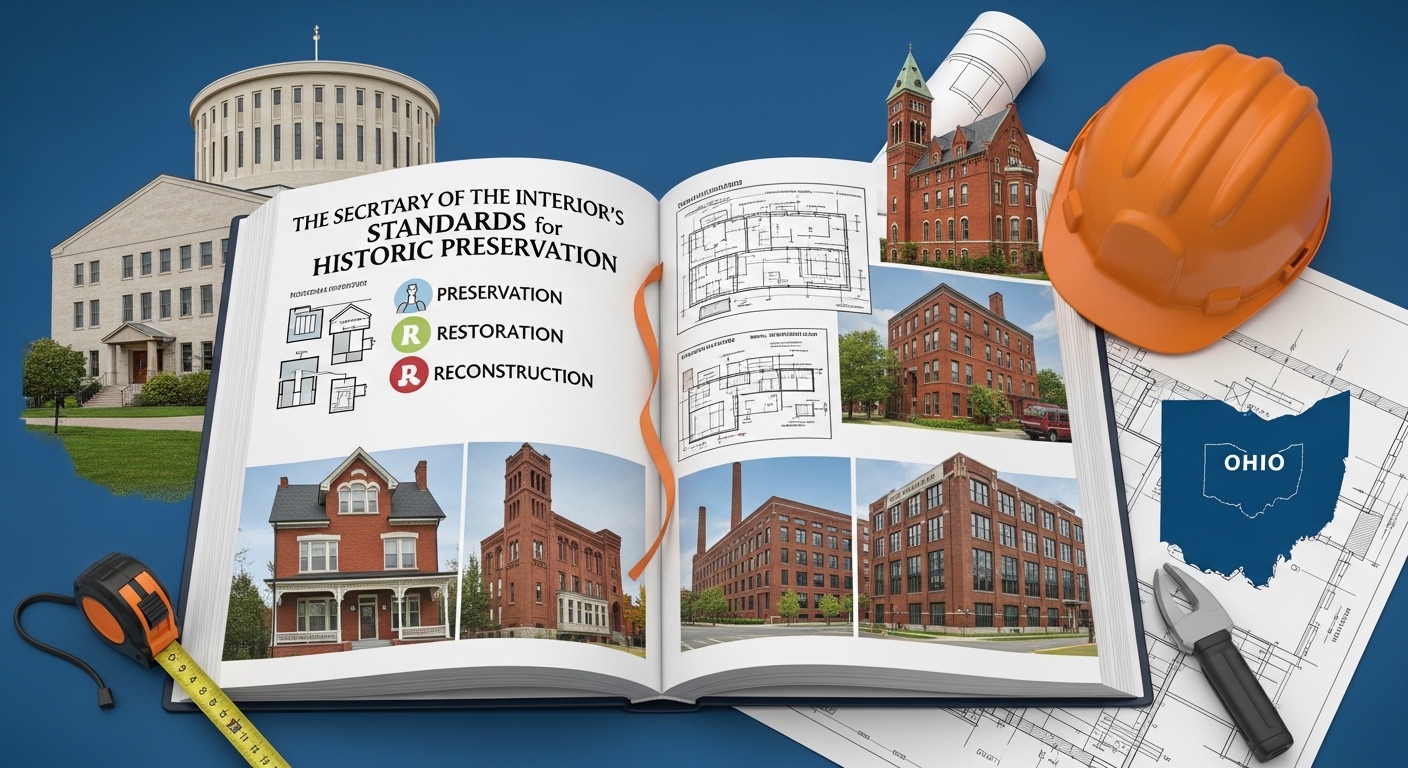
Picture this: you’ve just bought a gorgeous 1890s brick building in downtown Columbus — or maybe it’s a Victorian farmhouse in Granville. You want to bring it back to life. Maybe there’s a historic tax credit involved. And then someone mentions the Secretary of the Interior’s Standards for Rehabilitation, and your brain kind of… short-circuits.
Yeah. That happens a lot.
Here’s the thing — these Standards aren’t as intimidating as they sound. Once you break them down, they’re basically a really clear framework for respecting old buildings while making them work for modern life. And if you’re a homeowner in Ohio who’s about to hire a contractor (or is already mid-project), understanding these guidelines could save you serious money, keep your tax credits intact, and protect the character of your property.
So let’s walk through this together. If you want the bigger picture on why Ohio takes historic building preservation so seriously, that’s worth a read first — but even if you’re jumping in fresh, I’ve got you covered.
First Things First: What Are These Standards, Exactly?
The Secretary of the Interior’s Standards for Rehabilitation (let’s just call them “the Standards” because that full name is a mouthful) are a set of ten guidelines developed by the U.S. Department of the Interior. They’ve been around since 1977, and they apply to any historic property that’s being rehabilitated — meaning updated for a new use while preserving the parts that make it historically significant.
They’re not a law exactly. But they are the measuring stick for determining whether your project qualifies for the 20% Federal Historic Tax Credit, Ohio’s Historic Preservation Tax Credit, and other incentive programs. Ignore them, and you’re basically leaving money on the table — or worse, disqualifying a project that would’ve otherwise gotten significant financial support.
Think of them less as rules and more as a philosophy. The big idea is: do no harm to what’s historic, and make sure any new changes are distinguishable from the old ones — so future generations can understand what’s original and what’s modern.
[IMAGE: Side-by-side comparison of a historic storefront before and after a Standards-compliant rehabilitation — new windows match original proportions, original brick retained]
Before You Start: What You (and Your Contractor) Need to Know
Honestly, this is where a lot of Ohio homeowners get tripped up — they hire a contractor who’s great at general renovations but lacks experience with historic properties. The result? Work that’s beautiful but non-compliant. And at that point, your tax credit application is already in trouble.
Here’s what should be in place before any hammer swings:
- A Certified Historic Structure designation (or a determination of eligibility) from the Ohio Historic Preservation Office (OHPO)
- A clear scope of work document listing what’s being changed and what’s being preserved
- A contractor who knows the Standards — not just someone who’s heard of them
- Pre-approval from OHPO if you’re applying for state tax credits
- Documentation of the property’s existing condition (photographs, measured drawings)
That last one is huge. Before-and-after documentation isn’t just bureaucratic box-checking — it’s your evidence that you followed the Standards. Without it, you’re telling a story with no receipts.
The Standards, Step by Step (In Plain English)
There are ten Standards, and they build on each other. Here’s what each one actually means in practice — especially for Ohio homeowners and the contractors they’re working with.
Step 1 — Understand What Makes Your Property Historic
Standard 1 says: Use the property for its historic purpose, or find a new use that requires minimal change to its character.
In practice: if you have a historic mill, don’t gut it into a modern loft that erases every trace of its industrial past. Find a use — offices, a restaurant, event space — that works with the building’s bones, not against them.
For Ohio homeowners, this usually means: don’t turn a single-family Victorian into something that looks like it was built in 2015.
Step 2 — Preserve the Historic Character
Standard 2 says: Retain and preserve historic materials and features that convey the property’s historical significance.
This is the big one. Original brick, wood siding, decorative cornices, historic windows — these are the features that make a building what it is. You can clean them, repair them, or even stabilize them. But don’t replace them unless they’re truly beyond saving.
A really common mistake I’ve seen: homeowners replace original wood windows with vinyl to improve energy efficiency. There are ways to improve the thermal performance of original windows — storm windows, weatherstripping, interior panels — without losing the character. A good contractor who knows historic work will know these options.
Step 3 — Research Before You Renovate
Standard 3 says: Recognize each property as a physical record of its time, place, and use. Don’t create a false historical appearance.
In other words: don’t invent history. If your 1890s house never had Victorian gingerbread trim, adding it now is fabricating a story that isn’t true. That might sound harmless, but it actually undermines the integrity of the building as a historical document.
Before any restoration work, dig into the property’s history. Old photos, building permits, newspaper archives, and even Sanborn fire insurance maps can tell you what was originally there.
Step 4 — Repair, Don’t Replace
Standard 4 says: Most properties change over time; those changes that have acquired historical significance in their own right shall be retained and preserved.
Here’s where it gets interesting: sometimes the later changes to a building are historically significant too. A 1950s addition to a 19th-century schoolhouse might tell an important story about how the community grew. You don’t automatically strip away everything that isn’t “original.”
This requires judgment, which is another reason experienced contractors who understand preservation are worth their weight in gold.
[IMAGE: Close-up of skilled mason repointing original brick mortar on Ohio historic building — matching mortar color and joint profile to the original]
Step 5 — Use the Gentlest Methods Possible
Standard 5 says: Distinctive features, finishes, and construction techniques that characterize a property shall be preserved.
Standard 6 says: Deteriorated historic features shall be repaired rather than replaced.
These two go together. The guiding principle: always choose the least invasive option. Clean before you repair. Repair before you replace. If you must replace, match the original in design, color, texture, and material.
This is especially relevant for masonry work in Ohio. A lot of older buildings in cities like Cleveland, Cincinnati, and Toledo have original lime mortar joints. Repointing with modern Portland cement — which is harder than the original brick — can actually cause the brick itself to crack and spall. Matching the mortar composition matters.
Step 6 — New Work Should Be Distinguishable (But Compatible)
Standard 7 says: Repair or replace missing features using physical or documentary evidence.
Standard 9 says: New additions, exterior alterations, or related new construction shall be differentiated from the old.
This might be the most misunderstood part of the Standards. A lot of people assume “historic preservation” means everything has to look exactly like it did in the past. But actually, the Standards say new work should be compatible with the historic character, while still being distinguishable as new.
A new addition to a historic building shouldn’t try to look 120 years old. It should be clearly modern while still respecting scale, materials, and context. Think of it as a respectful conversation between old and new — not a forgery.
Step 7 — Don’t Damage What You Might Need Later
Standard 8 says: Chemical or physical treatments shall be the gentlest means possible.
Standard 10 says: New additions and adjacent or related new construction shall be undertaken in a manner that, if removed in the future, would leave the historic materials and character essentially unimpaired.
Standard 10 is the reversibility principle, and it’s one of my favorite concepts. The idea is: what you build today shouldn’t permanently destroy the historic fabric. If your addition were removed in 50 years, the original building should still be there, intact.
It’s like the Hippocratic oath, but for buildings.
Common Mistakes Ohio Contractors Make (And How to Avoid Them)
Look, even well-meaning contractors mess this up. Here are the patterns I see most often in Ohio historic preservation projects:
Replacing original windows with vinyl
It feels like an easy win for energy efficiency. But original wood windows are almost always repairable, and replacing them with vinyl is a non-compliance flag that OHPO reviewers catch immediately. Storm windows and proper weatherstripping are your friends here.
Power washing historic masonry
High-pressure washing can drive moisture into brick, erode soft historic stone, and damage original mortar. Low-pressure washing with appropriate detergents, or hand cleaning, is the compliant approach.
Adding historically inaccurate features
Sometimes homeowners want to add “period-appropriate” details that weren’t actually part of the original building. This creates a false history — which is exactly what the Standards are designed to prevent.
Not documenting work before it starts
If you skip the before photos and condition documentation, you have no way to prove compliance during review. Document everything, obsessively.
[IMAGE: Example of incorrectly installed vinyl replacement windows on a historic Ohio brick building — contrasted with properly repaired original wood windows on an adjacent structure]
Expert Tips That’ll Actually Make Your Project Easier
Get OHPO involved early — not when you’re already in trouble
Ohio Historic Preservation Office staff are actually really helpful during the planning phase. They can review preliminary scope-of-work documents and flag issues before they become expensive problems. Don’t wait until you’ve started demoing walls.
Hire a preservation architect or specialist for complex projects
For significant historic properties — especially ones with tax credit applications involved — a preservation architect isn’t a luxury. They understand the Standards deeply and can save you from costly mistakes. Their fee usually pays for itself in avoided headaches.
The Standards have interpretive flexibility — use it
These aren’t rigid rules applied the same way in every situation. OHPO reviewers consider context, condition, and significance. A feature that’s deteriorated beyond reasonable repair, or one that’s not historically significant, may be treated differently than a defining architectural element. Know which features matter most, and protect those above all else.
Ohio’s tax credits make compliance financially worthwhile
Ohio’s Historic Preservation Tax Credit program can cover 25% of qualified rehabilitation expenditures for income-producing properties. Combined with the federal 20% credit, you’re looking at potentially 45 cents on every dollar spent. That’s not trivial — that’s a reason to hire the right contractor and follow the Standards carefully from day one. More on that in our Ohio historic preservation overview.
The Quick Recap (And What to Do Next)
Okay, let’s land this plane.
The Secretary of the Interior’s Standards for Rehabilitation are ten guidelines that define what it means to update a historic building responsibly. They’re not about freezing time — they’re about respecting what’s there while making the building work for today.
Here’s what matters most for Ohio homeowners and contractors:
- Identify and preserve the character-defining features first
- Repair before you replace — always
- Document everything before, during, and after
- Get OHPO involved early if tax credits are part of the picture
- New work should be compatible but distinguishable — not a forgery
- Reversibility matters — don’t permanently damage what you might want back
And honestly? The most important thing is working with people who’ve actually done this before. The Standards are easier to follow when you have a contractor who already knows them — who doesn’t have to look them up, who catches potential issues before they become problems, who’s navigated OHPO reviews before.
If you’re planning a rehabilitation project in Ohio and want to make sure it’s done right — both for the building’s sake and for your bottom line — reach out to K&K Construction. We’ve been doing this work in Ohio for years and we genuinely love it. Historic buildings deserve care. And so do the people trying to bring them back to life.
Quick Answers: FAQ
Do the Standards apply to every old building in Ohio?
Not automatically. They apply when you’re seeking historic tax credits or when the building is listed on the National Register of Historic Places (or eligible for listing). If neither of those applies, you have more flexibility — but following the Standards is still good practice for preserving long-term value.
Can I make my historic home more energy efficient?
Absolutely — but it requires the right approach. Insulating interior walls, installing storm windows, adding weatherstripping, and upgrading mechanical systems can all significantly improve energy performance without violating the Standards. What you can’t do is replace original exterior features (like windows) with modern materials that alter the historic character.
What happens if my contractor doesn’t follow the Standards?
If you’re in the middle of a tax credit application, non-compliant work can disqualify the entire project — even work that was already done. OHPO reviewers evaluate the project as a whole. This is why getting approval before you start, not after, is so important.
Who enforces the Standards in Ohio?
The Ohio Historic Preservation Office (OHPO) is the state-level authority that reviews rehabilitation projects seeking Ohio Historic Preservation Tax Credits. For projects involving the federal tax credit, the National Park Service has ultimate authority — but OHPO acts as the first line of review. Learn more about how this works in context at our historic preservation in Ohio page.