
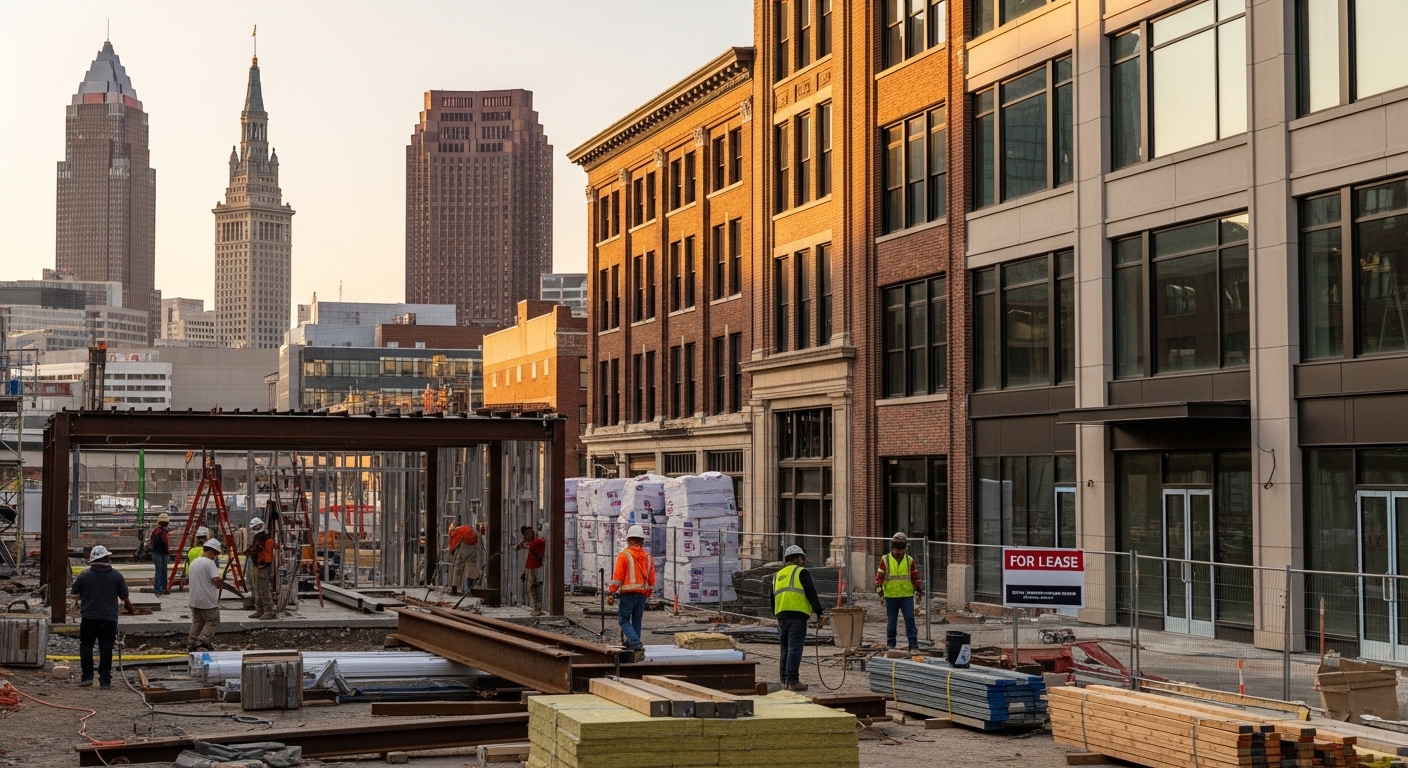
A few years ago, a building owner in the Gordon Square neighborhood bought a vacant storefront that had been vacant for about a decade. Beautiful bones — original tin ceiling, brick facade, big display windows. He had a vision: pull it back to life, get tenants in, maybe keep the ground floor for his own business.
He got three contractor bids. The lowest came in at $280,000. The highest was $410,000. He went with the middle one — $340,000 — figuring that was the safe bet. Smart, right?
Eighteen months and $520,000 later, he had his building. And honestly? He’d do it again. But he told me he wished someone had sat him down before the project and said: here’s what commercial rehabilitation in Cleveland actually involves. Not the marketing version. The real version.
That’s what this article is. If you’re thinking about a commercial rehab project in the Cleveland area — whether it’s a mixed-use building, an old warehouse, a retail space, a former factory — this is the conversation I wish more people had before they started.
And if you want to talk through your specific project with people who know this market, the team at K&K Construction in Cuyahoga County has been through this exact process dozens of times.
First, Let’s Be Clear About What “Commercial Rehabilitation” Actually Means
Because people use this phrase loosely, and it matters. Commercial rehabilitation — sometimes called commercial rehab — is the process of bringing an existing commercial building back to functional use, usually with significant structural, mechanical, and cosmetic work involved.
It’s different from a simple renovation or refresh. A rehab project typically means you’re dealing with a building that’s been neglected, partially damaged, or significantly out of date — often all three at once.
In Cleveland and the surrounding Cuyahoga County area, this usually falls into a few categories:
- Adaptive reuse: converting an old industrial or commercial building to a new purpose (think warehouse-to-apartment or factory-to-office)
- Historic rehabilitation: restoring a building to active use while maintaining its historic character
- Distressed property rehab: taking a neglected or damaged building and making it functional and leasable again
Each one has different cost drivers, different timelines, and different regulatory landscapes. But they share a common reality: they’re almost always more complicated than they look at the start.
The Cost Reality: What Are We Actually Talking About?
Alright, let’s get into numbers. I’ll be upfront: there’s a wide range here, and anyone who gives you a firm per-square-foot estimate without seeing your building is guessing. But here’s a realistic framework based on what commercial rehab projects in the Cleveland area actually cost.
Light Rehabilitation
This covers buildings that are structurally sound but need significant cosmetic work, updated mechanical systems, and general modernization. Think: updating a 1980s office building, refreshing a retail strip that’s been poorly maintained.
Rough range: $50–$100 per square foot
What drives the high end: outdated electrical that needs full replacement, HVAC systems past their useful life, ADA compliance upgrades, exterior envelope work.
Moderate Rehabilitation
Now we’re talking about buildings that have real issues — deferred maintenance, partial structural problems, major system failures, possible asbestos or lead paint remediation. This is probably the most common category for Cleveland-area commercial projects.
Rough range: $100–$180 per square foot
What drives the high end: environmental remediation, significant structural repairs, full gut of interior systems, required code upgrades that affect the entire building.
Substantial/Historic Rehabilitation
This is the full category — often historic buildings, adaptive reuse projects, or seriously distressed properties. You’re essentially rebuilding from the inside out while preserving (or restoring) the exterior and structural shell.
Rough range: $180–$300+ per square foot
What drives costs: specialized historic preservation materials and trades, extensive structural work, complete systems replacement, preservation board review processes that affect scheduling and material choices.
For reference: a 10,000-square-foot moderate rehab in Cleveland might realistically cost $1.2–$1.8 million. A historic storefront building at 4,000 square feet might run $600,000–$900,000 fully done. These aren’t meant to scare you. They’re meant to help you plan.
What Actually Eats the Budget (The Honest Version)
Here’s what I’ve seen trip up commercial rehab budgets in Cleveland, in rough order of how often they surprise people:
Hidden Environmental Issues
Buildings built before 1978 almost certainly have lead paint. Many have asbestos in floor tiles, ceiling tiles, pipe insulation, and roofing materials. You won’t know the full extent until demolition begins.
Environmental remediation isn’t just expensive — it’s slow. It requires licensed abatement contractors, air quality testing, disposal documentation. On a 5,000-square-foot building, remediation alone can run $30,000–$80,000 or more depending on what’s there.
Budget for it. Assume it’s there, even if pre-purchase assessments suggest it’s minor.
Structural Surprises
Old commercial buildings in Cleveland were built to different standards. Floor load ratings, beam spans, foundation conditions — these things look fine until you open the walls. I’ve seen projects where removing a non-structural-looking partition revealed a load-bearing condition that required a full structural engineer redesign.
This is why experienced contractors do preliminary demolition before finalizing scopes. It costs a little more upfront but saves you from redesigning mid-project.
Mechanical, Electrical, and Plumbing (MEP) Costs
This is the category most people underestimate. New HVAC for a commercial building. Full electrical service upgrades. Plumbing that needs to be rerouted entirely because the original layout no longer makes sense. In a major rehab, MEP can represent 30–40% of total project cost.
And here’s the thing: MEP costs don’t scale with square footage as cleanly as you might expect. A 2,000-square-foot space can have nearly as much electrical and plumbing work as a 6,000-square-foot space if the systems are in similar shape.
Code Compliance and Accessibility
When you substantially rehabilitate a commercial building, you trigger code compliance requirements across the board. ADA accessibility — ramps, door widths, restroom configurations, parking. Fire suppression systems if the building hits certain thresholds. Energy code compliance for new mechanical systems. Egress requirements that might require moving or adding doors.
None of this is optional. And all of it costs money that doesn’t always show up in initial estimates.
What I’ve Learned From Cleveland-Area Rehab Projects
A few things I’d tell any property owner starting a commercial rehab in this market:
The Tax Credit Math Is Worth Doing Seriously
Ohio’s Historic Preservation Tax Credit can cover up to 25% of qualified rehabilitation expenses. The federal Historic Tax Credit adds another 20% for certified historic structures. On a $1 million project, that’s potentially $450,000 in tax credits.
Cleveland has a lot of eligible buildings — and a lot of property owners who don’t realize their project qualifies, or who miss the application window because they didn’t know credits had to be approved before construction began.
Talk to a preservation consultant or CPA with historic tax credit experience before you do anything else. The paperwork is real, but so is the money.
Phasing Is Often Smarter Than All-at-Once
Especially for larger buildings or mixed-use projects, phasing the rehabilitation can be the difference between a project that gets finished and one that stalls at 60% because the budget ran out. Many successful Cleveland-area rehab projects start with one floor or one section, generate revenue from leasing, and fund the next phase from that income.
It takes longer. But it’s actually finished.
The Contractor You Choose Matters More Than Almost Anything
Commercial rehab is genuinely specialized work. Not every general contractor has the experience to manage environmental abatement, coordinate preservation board reviews, sequence work around structural unknowns, and keep a complex project moving when surprises come up.
In Cuyahoga County, K&K Construction has built a track record on exactly these kinds of projects. When you’re vetting contractors, ask specifically about past commercial rehab work, how they handle budget contingencies, and how they communicate when the unexpected happens. Their answers will tell you a lot.
Timeline Is Usually Double What You Expect
I don’t say this to be discouraging. I say it because people who plan for a 12-month project and it takes 20 months are okay — stressed, but okay. People who plan for 8 months and it takes 18 months sometimes make decisions in month 10 that they regret for years.
Permitting in Cuyahoga County municipalities takes time. Historic review boards have their own schedules. Specialized subcontractors are often booked out. Material lead times on historic-compatible products can be long. Build in time — real time, not optimistic time.
Before You Start: A Practical Checklist
If you’re in early-stage planning for a commercial rehab in Cleveland, here’s what I’d prioritize:
- Get a Phase I and Phase II environmental assessment done. Know what you’re dealing with before you buy or before you budget.
- Hire a structural engineer for a preliminary assessment. Not after the contractor bids — before.
- Check historic designation status: National Register, Ohio Historic Preservation Office, and local municipal designation.
- Talk to a tax credit consultant before you finalize your project scope.
- Get contractor bids that include a preliminary demo phase so scope can be confirmed.
- Budget 15–20% contingency. Not 10%. Not 5%. If you don’t use it, great — you have money left over.
- Talk to your local building department and, if applicable, historic preservation commission early. Surprises in those relationships cost the most.
Frequently Asked Questions
Do I need a special permit for commercial rehabilitation in Cleveland?
Yes — and potentially several. Commercial rehab projects require building permits from your municipality, and if the building is historically designated, you’ll also need approval from the relevant historic preservation commission. The permit process for substantial rehab work often involves multiple departments and multiple inspections. Start the permit conversation early — it’s not unusual for permit review alone to take 6–12 weeks.
Can I live in a building while it’s being rehabilitated?
For commercial buildings, this is less of a residential concern — but if you’re doing a mixed-use project where you’re also occupying part of the space, generally: it depends on the scope of work. Active construction affecting life-safety systems (electrical, fire suppression) usually requires vacating those areas. Your contractor and permit authority will have specific requirements for your project.
Is commercial rehabilitation in Cleveland worth it financially?
Honestly, it depends on your specific building, location, and financing. The short answer is: it can be enormously worth it, especially when tax credits are in play and the location has real market demand. Cleveland’s historic neighborhoods — Ohio City, Tremont, Detroit Shoreway, Gordon Square, parts of the East Side — have seen strong commercial and mixed-use demand. But the math has to work for your specific situation. Don’t assume it does — run the numbers with real estimates, not optimistic ones.
How do I find contractors with commercial rehab experience in Cuyahoga County?
Start with referrals from local development corporations, preservation organizations like Preservation Cleveland, or your city’s building department. Ask for specific examples of completed commercial rehab projects, not just general commercial construction. K&K Construction is one contractor with deep experience in Cuyahoga County commercial and historic rehabilitation work.
What’s the difference between rehabilitation and renovation?
In common usage, renovation usually means updating or improving a building that’s still functional. Rehabilitation typically implies a more substantial effort — bringing a building back from significant distress or disuse. In the context of historic preservation and tax credits, “rehabilitation” has a specific technical meaning: work that allows a property to be used while preserving its historic character. The distinction matters for financing and regulatory purposes.
The Building That Building Owner Finished
Remember that Gordon Square storefront from the beginning? Last I heard, it’s fully occupied. Ground floor is a restaurant. Second floor is office space. The tin ceiling is still there. The brick facade was repointed and looks the way it probably looked in 1920.
He spent more than he expected. It took longer than he planned. And he’d still tell you it was one of the best decisions he ever made.
That’s kind of the nature of commercial rehabilitation in Cleveland. The bones of this city are genuinely worth saving. The market for well-done, well-located commercial space is real. And the path from “vacant and deteriorating” to “something people are proud of” — while not easy — is absolutely doable.
The key is going in clear-eyed. Knowing the real costs. Understanding the process. Having the right team.
If you’re thinking about a commercial rehab project in the Cleveland or Cuyahoga County area and want to talk through what it might actually look like for your building, K&K Construction is a good place to start. No pressure — just a real conversation with people who’ve done this work and know this market.
Because the best projects start with the right information. And now you’ve got some of it.