
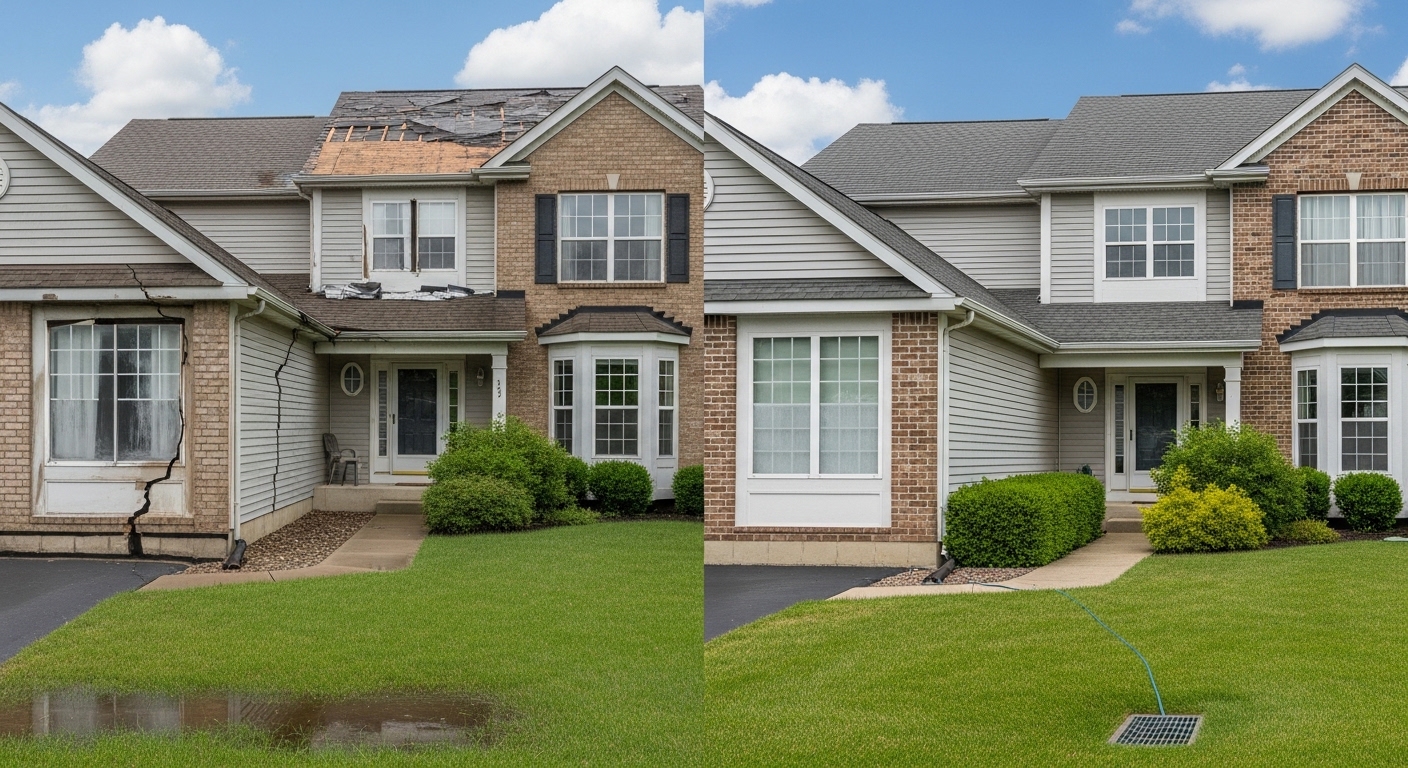
You know that feeling when something in your house starts acting weird, and you can’t tell if it’s a $200 fix or a $20,000 problem?
That low-grade dread. The mental math you do at 2 am. The way you start googling things you probably shouldn’t Google at 2 am.
Summit County homeowners deal with this more than most, honestly. The housing stock here skews older — a lot of Craftsman bungalows, mid-century ranches, post-war two-stories. Beautiful homes with real character and real history. But character and history come with a list of recurring issues that show up over and over in homes across Akron, Cuyahoga Falls, Stow, Twinsburg, and the rest of the county.
The good news? Most of them are fixable. And understanding what you’re dealing with — really understanding it, not just “I googled it for ten minutes” understanding — makes all the difference between panicking and solving.
This is that article. A straight look at what goes wrong in Summit County homes, why it happens, what your options are, and how to make a smart call about what to do.
If you want to talk through any of this for your specific home, K&K Construction serves Summit County and can give you an honest read on what you’re dealing with.
Issue #1: Basement Water Intrusion
This is the big one. If you’ve owned a Summit County home for more than a few years, you’ve probably had some version of this conversation with yourself: is that a water stain, or has that always been there?
Summit County’s soil composition — heavy clay in a lot of areas — doesn’t drain well. Add Ohio’s freeze-thaw cycles and we get pretty serious precipitation totals, and you’ve got a recipe for hydrostatic pressure pushing moisture against your foundation walls.
What it looks like
Efflorescence (that white chalky stuff on your basement walls), damp spots after heavy rain, actual water pooling on the floor, musty smell that never quite goes away, or visible cracks in the foundation.
Your options
Interior waterproofing involves installing a drainage system along the interior perimeter of your basement, typically with a sump pump to move the water out. It doesn’t stop water from entering the wall — it intercepts it and routes it away. Less invasive, generally less expensive.
Exterior waterproofing means excavating around your foundation, applying a waterproof membrane to the exterior wall, and improving drainage around the house. It addresses the source, not just the symptom. More invasive, more expensive, but more thorough.
Crack injection is for specific foundation cracks — not a whole-basement solution, but a targeted fix when the issue is localized.
Pros and cons
Interior waterproofing is faster, cheaper ($3,000–$10,000 for most homes), and doesn’t require excavation. The downside is you’re managing water that’s already gotten in, not stopping it at the source. It works well for most residential situations.
Exterior waterproofing is the gold standard — you’re actually solving the problem — but it costs $15,000–$30,000+ and involves significant disruption to your landscaping and grade.
The honest recommendation
For most Summit County homeowners with moderate moisture issues, interior waterproofing with a quality sump pump gets the job done. If you’re seeing significant foundation cracking, bowing walls, or major water volume, get a structural engineer involved before you spend money on either solution.
Don’t let any contractor sell you exterior waterproofing on a house that just needs a better sump pump. And don’t let anyone talk you out of exterior waterproofing if your foundation is actually compromised.
Issue #2: Aging Knob-and-Tube or Aluminum Wiring
A lot of Summit County’s older homes — anything pre-1950, and some into the 60s — still have original knob-and-tube wiring. Homes from the 70s sometimes have aluminum wiring for branch circuits, which comes with its own set of issues.
Neither of these is an automatic crisis. But both deserve attention.
Knob-and-tube: what you’re dealing with
Knob-and-tube (K&T) is actually not inherently dangerous in its original condition. The problem is what happens to it over decades: insulation gets piled on top of it (it needs air circulation to cool), it gets spliced poorly during amateur repairs, or the cloth insulation just degrades over time.
The real issue: It’s ungrounded, it’s not designed for modern electrical loads, and insurance companies increasingly won’t cover homes with active K&T — or they’ll charge significantly higher premiums.
Aluminum wiring: the specific concern
Aluminum expands and contracts more than copper, which causes connections to loosen over time. Loose connections arc. Arcing causes fires. The fix isn’t always full rewiring — sometimes pigtailing with copper at connection points is sufficient, but it has to be done correctly.
Your options compared
| Knob-and-Tube | Aluminum Wiring | |
|---|---|---|
| Safety risk | Moderate (condition-dependent) | Moderate at connections |
| Fix type | Usually full rewiring | Pigtailing or full rewiring |
| Cost | $8,000–$20,000+ | $1,500–$8,000 |
| Insurance impact | Often uninsurable | Usually insurable with documentation |
| DIY-able? | No | No |
The recommendation
Get a licensed electrician to assess it — not a handyman, a licensed electrician. They’ll tell you exactly what you’re dealing with and what the fix actually needs to be. Don’t spend money on rewiring until you know whether pigtailing is sufficient. And don’t ignore it because “it’s been fine for 60 years” — that logic works until it doesn’t.
Issue #3: Failing or Outdated HVAC Systems
Summit County gets real winters. Not “wear a sweater” winters — actual Ohio winters where your furnace is doing meaningful work from November through March. An aging HVAC system isn’t just an efficiency issue; it’s a comfort and reliability issue.
The comparison: repair vs. replace
This is where most homeowners get stuck. The furnace acts up, the technician comes out, and suddenly you’re deciding between a $600 repair and a $5,000 system replacement with no good framework for the decision.
Here’s the framework I’d use:
Repair makes sense when:
- The system is under 10 years old
- The repair cost is less than 50% of the system’s remaining value
- The system has been reliable and this is a one-off issue
Replace makes sense when:
- The system is 15+ years old (furnaces, 20+ for some)
- You’ve been repairing it repeatedly
- Energy bills are climbing without explanation
- It can’t maintain temperature on cold days
Heat pump vs. gas furnace: the current debate
A lot of Summit County homeowners are being asked to consider heat pumps when they replace aging systems. Here’s the honest take:
Modern cold-climate heat pumps are genuinely capable in Ohio winters — they’ve come a long way in the last five years. They’re more efficient than gas in moderate temperatures and they handle cooling too. The upside is one system for both heating and cooling, lower operating costs if electricity rates cooperate, and eligibility for federal tax credits through 2032.
The downside is higher upfront cost and the reality that in very cold snaps (we’re talking single digits), most heat pumps need a backup heat source. A hybrid system — heat pump with gas backup — is often the best of both worlds for Summit County’s climate.
Cost comparison:
- Gas furnace replacement: $3,000–$6,000 installed
- Central AC replacement: $3,500–$7,000 installed
- Heat pump (does both): $5,000–$12,000 installed
- Hybrid system: $7,000–$14,000 installed
Issue #4: Roof Problems
Summit County’s freeze-thaw cycles are rough on roofs. Ice dams — where water backs up under shingles because heat escapes through the attic unevenly — are a specific regional problem that causes damage that gets worse over time and often isn’t visible from the ground.
Spotting the issues
Ice dams show up as icicles at the eaves, water stains on interior ceilings near exterior walls, or shingles that look buckled or lifted in the spring. Granule loss from aging asphalt shingles shows up as dark patches or a sandpaper texture to the shingles (and granules in your gutters).
Repair vs. replace: the real question
A roof repair makes sense for isolated damage — a few missing shingles, flashing around a chimney or vent that’s failed, a small section that took storm damage. If the underlying structure is sound and the rest of the roof has life left, repair is smart.
Replacement makes sense when the shingles are 20+ years old (most asphalt shingles have a 25–30 year lifespan but real-world performance is shorter in Ohio’s climate), when you’re seeing multiple problem areas, or when a home inspection has flagged the roof’s age as a concern.
And the ice dam problem specifically: The actual fix is attic insulation and ventilation, not just better shingles. If your attic isn’t properly insulated and ventilated, you’ll keep having ice dams no matter how new the roof is. Address the cause, not just the symptom.
Issue #5: Foundation Cracks and Settlement
Not every foundation crack is a crisis. That’s the first thing to know. Hairline cracks in concrete block or poured concrete walls are common and often benign — concrete shrinks slightly as it cures, and that process creates minor cracking.
But some cracks are worth serious attention.
How to read what you’re seeing
Hairline vertical cracks — usually shrinkage, monitor but don’t panic.
Horizontal cracks — this is the one that should get your attention immediately. Horizontal cracking in a block foundation wall indicates lateral pressure — the soil is pushing the wall inward. This is a structural issue and it gets worse over time.
Stair-step cracks in block walls — often indicates differential settlement. Worth having looked at.
Wide cracks (1/4 inch or more) — get a structural engineer involved regardless of direction.
Your options
For horizontal cracking and bowing walls, the common fixes are carbon fiber straps (which stabilize the wall but don’t push it back), wall anchors (which can gradually straighten the wall over time), or steel I-beam reinforcement. The right choice depends on how far the wall has moved and how active the problem is.
For settlement issues, underpinning with helical piers or push piers can stabilize and sometimes lift a settled foundation.
None of this is cheap. But it’s the kind of thing that gets dramatically more expensive the longer you wait.
Decision Framework: How to Think About Any of These Issues
When something goes wrong in your house, here’s a way to think through it that’s actually useful:
First: Is this a safety issue? Active water near electrical, structural movement, carbon monoxide — these are “stop and call someone today” situations. Everything else can be assessed more calmly.
Second: Is this getting worse? A stable problem is different from a worsening one. If the crack hasn’t changed in two years, that’s different from one that’s grown half an inch this winter.
Third: What’s the cheapest fix that actually solves it? Not the cheapest fix that patches it temporarily. The cheapest fix that addresses the actual cause. That’s the calculation that saves you money long-term.
Fourth: Get more than one opinion on anything over $3,000. Not to find the cheapest price — to understand what you’re actually dealing with. Different contractors will sometimes tell you very different things. Understanding why helps you make a better decision.
FAQ
How do I know if my Summit County home has knob-and-tube wiring? Have a licensed electrician check your attic and basement. K&T looks like ceramic knobs holding wires away from framing, and ceramic tubes where wires pass through framing. If your home was built before 1950, there’s a reasonable chance some is still active.
Are Summit County home inspectors required to flag foundation issues? Yes — licensed home inspectors are required to note visible foundation concerns. But inspectors aren’t structural engineers. If an inspection raises a flag, the right next step is a structural engineer’s assessment, not just another contractor quote.
How much should I budget annually for home maintenance in an older Summit County home? The old rule of 1% of home value per year is actually low for older homes. Budget 1.5–2% for homes over 40 years old. It sounds like a lot until you’ve had to replace a furnace and a water heater in the same winter.
Can I get grants or assistance for home repairs in Summit County? Yes — Summit County and the City of Akron both have programs for income-qualifying homeowners. The Summit County Land Bank and Ohio’s Housing Finance Agency are worth looking into. Programs change, so check directly with the county for current availability.
The Bottom Line
Older homes in Summit County are worth owning. They’ve got character, solid construction, and established neighborhoods. But they come with a list of issues you need to be ready for.
The homeowners who do best with these houses are the ones who go in with clear eyes — who know what to watch for, get ahead of problems before they compound, and make decisions based on actual information rather than panic or procrastination.
If you’re dealing with any of these issues and want a straight conversation about what you’re looking at, reach out to K&K Construction’s Summit County team. Not to sell you something — just to give you an honest read on what’s worth doing and what can wait.
That’s the kind of help that actually makes homeownership feel manageable.