
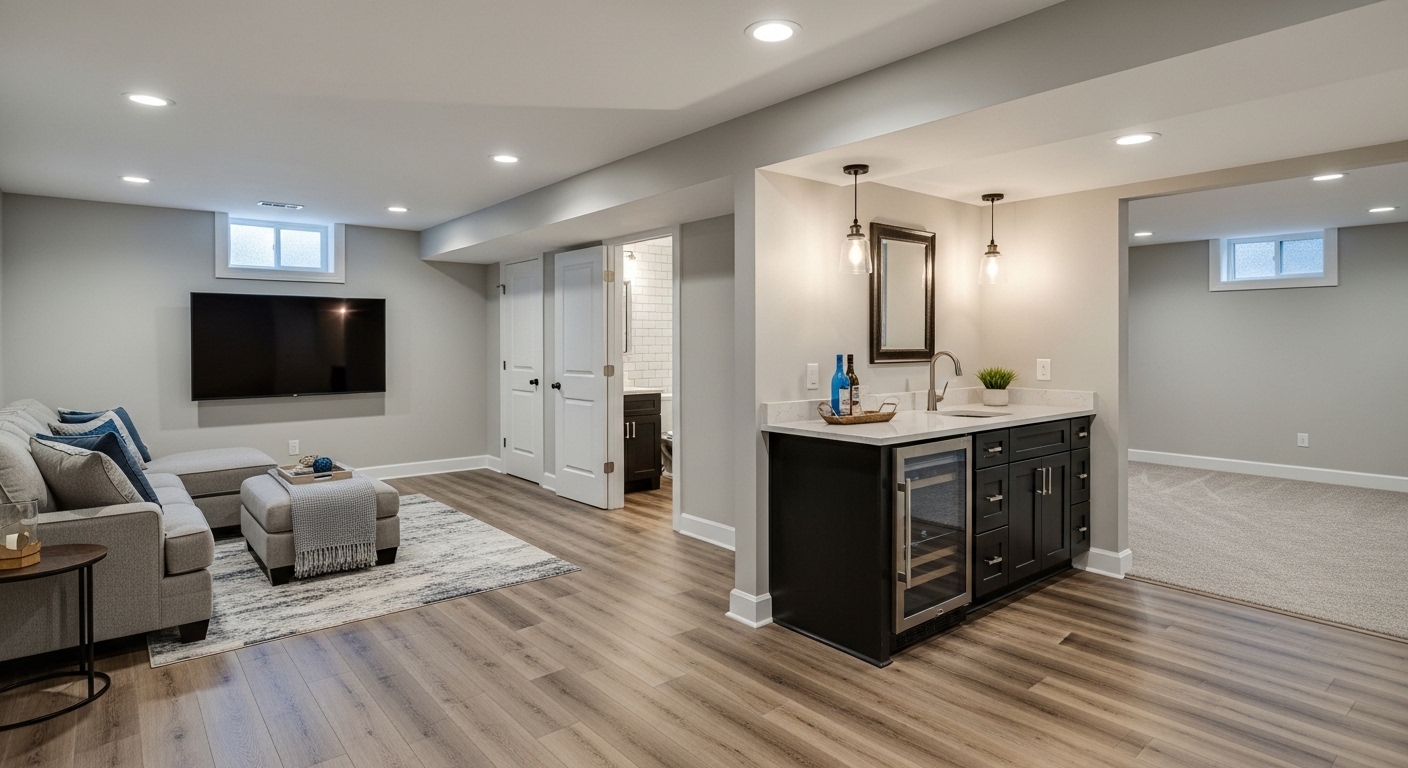
So you’ve got an unfinished basement. Maybe it’s been sitting there for years — damp, dimly lit, full of holiday decorations and that treadmill you were definitely going to use. And now you’re thinking: what if I actually finished this thing?
Good news — you’re not alone. Basement finishing is one of the most popular home improvement projects in northeast Ohio, and honestly, for good reason. You’re adding livable square footage without building an addition. You’re not touching the roof. The bones are already there.
But here’s the thing nobody tells you upfront: there’s a pretty wide gap between “finishing a basement” and actually finishing a basement well. And that gap? It lives mostly in the planning, the permits, and the details.
Let’s walk through all of it — what it costs, what’s involved step by step, and what to watch out for along the way.
Before You Do Anything: What You Need to Know First
Before you pick paint colors or browse flooring samples, there are a few things worth checking that’ll save you real headaches later.
Moisture is the make-or-break issue. In Akron specifically — where we get solid rainfall and freeze-thaw cycles every winter — basement moisture problems are common. If you’ve ever noticed water stains along the foundation walls, musty smells, or efflorescence (that white chalky stuff that forms on concrete), those need to be addressed before any finishing work starts. Finishing over a moisture problem doesn’t fix it. It hides it. And then you’re ripping out drywall in two years. Not fun.
Ceiling height matters more than you think. Ohio’s building code requires a minimum ceiling height for finished living space — typically 7 feet in most areas, though it can vary. Measure yours before you fall in love with the idea. Ductwork and beams can eat into that height too, so be realistic about what the space can actually become.
Permits aren’t optional. Any legitimate basement finishing project in Akron requires permits through Summit County. This isn’t just bureaucratic hassle — it protects you when you sell. An unpermitted finished basement can complicate or kill a real estate transaction. Get the permit.
Step 1: Figure Out What You Want the Space to Do
[IMAGE: Split image showing a finished basement media room on one side and a finished basement home office/guest suite on the other, showing two common use cases]
Here’s where a lot of people skip ahead too fast. They just start getting quotes without being clear on the function of the space.
Are you building a:
- Family/media room? You’ll want to think about lighting, sound, outlets for a TV setup, maybe a wet bar.
- Guest suite or in-law space? Now you’re probably looking at a full bathroom, which adds significant cost and complexity.
- Home office or gym? Different flooring needs, potentially different HVAC considerations.
- Combination of the above? Totally doable, but the layout planning gets more involved.
The reason this matters at the start is that every answer changes the scope of the project — and therefore the cost. A simple media room and a guest suite with a full bath can be $30,000 apart in total price. Knowing what you want upfront helps you plan and budget honestly.
Step 2: Budget Realistically for Akron Basement Costs
Let’s talk numbers, because this is what everyone really wants to know.
In the Akron/Summit County area, basement finishing typically runs between $25 and $60+ per square foot, depending on finish level and what’s involved. Here’s a rough breakdown of what that looks like in practice:
Basic finish (framing, drywall, flooring, paint, basic lighting): $25–$35/sq ft — You’re looking at a functional but simple space. Good bones, no frills.
Mid-range finish (full drywall, recessed lighting, LVP flooring, egress window if needed, basic bath rough-in): $40–$55/sq ft — This is where most homeowners land. A real room that feels like part of the house.
High-end finish (full bathroom, custom built-ins, wet bar, premium materials throughout): $55–$75+/sq ft — You’re basically building a really nice apartment down there.
So what does that look like on a real basement?
A typical 1,000 square foot unfinished basement in Akron:
- Basic finish: $25,000–$35,000
- Mid-range: $40,000–$55,000
- High-end with bathroom: $60,000–$90,000+
And yes, adding a full bathroom is a significant jump — typically $8,000–$20,000 on top of everything else, depending on whether plumbing rough-ins already exist and how complex the layout is.
A few costs that surprise people:
Egress windows. If you want a legal bedroom down there, you need a proper egress window — a window large enough to escape from in an emergency. In Akron, these typically run $2,500–$5,000 installed, including the excavation and well.
Electrical upgrades. Most older homes don’t have enough electrical capacity in the panel for a fully finished basement. Budget for at least some electrical work.
Waterproofing. If you need it, it’s not optional — and it’s often $5,000–$15,000 depending on severity. Get it done before the finish work. Always.
If you’re in the greater Akron area, the team at K&K Construction can walk you through what’s realistic for your specific space and give you a clear estimate before you commit to anything.
Step 3: Plan the Layout Before Anyone Touches a Wall
[IMAGE: Simple basement floor plan sketch showing key zones — open living area, bathroom, utility room, storage — with measurements labeled]
Good layout planning is honestly underrated. This is where you work out:
- Where the utility room and mechanicals will be accessible (you always need access to your water heater, furnace, electrical panel — they can’t be buried behind a wall)
- How you’ll handle the support columns (most Akron basements have at least a couple — they can often be incorporated into a built wall or wrapped)
- Where natural light comes from (and whether you’re adding any windows)
- Traffic flow between spaces
Sketch it out. Even a rough sketch helps. Most contractors will help you refine this, but coming in with a rough idea of what you want saves time and keeps the conversation more productive.
Step 4: The Actual Construction Sequence
Here’s roughly how a basement finishing project unfolds, in order. Understanding this helps you set realistic expectations for timeline.
Moisture remediation (if needed) — Weeks 1–2 This comes first, always. Waterproofing, crack repair, sump pump installation if needed. You don’t build on an unsolved problem.
Framing — Days 2–5 Steel or wood studs go up to create the wall structure. Rooms take shape. This goes faster than most people expect.
Rough-in MEP (Mechanical, Electrical, Plumbing) — 1–2 weeks Electricians, plumbers, and HVAC folks do their work before walls are closed. This is where you add circuits, run supply and return lines, extend HVAC. This phase requires inspection before the walls close.
Insulation — 1 day Basement walls typically get rigid foam or batt insulation. Important for both comfort and energy efficiency.
Drywall — 3–5 days Hang, tape, mud, sand. This phase has a lot of drying time built in, which is part of why basements take longer than people expect.
Flooring — 1–3 days LVP (luxury vinyl plank) is hugely popular in basements because it handles moisture well and looks great. Carpet is an option in dry basements for media rooms or bedrooms. Tile in bathrooms.
Painting, trim, fixtures — 1 week The finishing touches that make it feel like a real room.
Final inspection and CO — Required before you use the space.
Total timeline: Most basement finishing projects in Akron take 6–12 weeks from start to finish, depending on scope and contractor scheduling. If anyone’s promising you a finished basement in two weeks, ask a lot of questions.
Step 5: Work With the Right Contractor
[IMAGE: Contractor reviewing blueprints with homeowner in an unfinished basement, pointing to a wall]
This is honestly where the project succeeds or fails. The best materials and plans don’t matter much if the execution isn’t solid.
Here’s what to look for when choosing a basement finishing contractor in Akron:
They pull permits. This is non-negotiable. If a contractor suggests skipping permits to “save money,” walk away.
They have local experience. Basement conditions in northeast Ohio are specific — moisture, soil, older housing stock. You want someone who’s worked in this region and understands what to expect.
They show you real references. Not just Google reviews — actual past clients you can call or photos of completed local projects.
They explain what they’re doing and why. A good contractor treats you like an intelligent adult. If someone’s giving you vague answers or seems annoyed by your questions, that’s information.
They give you a detailed written estimate. Not a ballpark. A line-item breakdown so you know what you’re paying for.
The K&K Construction team serves Summit County and specializes in exactly this kind of project — they understand the local permitting process, the moisture challenges specific to this region, and how to build basement spaces that hold up over time.
Common Problems (and How to Avoid Them)
Problem: Starting before addressing moisture Solution: Get a moisture assessment first. It takes a couple hours and can save you tens of thousands. If the contractor doesn’t bring this up, you bring it up.
Problem: Underestimating the cost of a bathroom Solution: Be upfront with yourself early. If you want a bathroom, price it in from the start — don’t treat it as an afterthought.
Problem: Losing access to mechanicals Solution: Your floor plan needs to account for your water heater, furnace, and electrical panel from day one. Make sure there are clear access panels or dedicated utility space.
Problem: Bad lighting plans Solution: Basements have no natural light except through egress windows. Lighting design actually matters down here more than anywhere else in the house. Recessed lighting on dimmers, layered with some floor lamps, makes a huge difference.
Problem: Choosing the wrong flooring Solution: Even if you solve your moisture problem, basements are still more humid than above-grade spaces. LVP flooring is specifically designed for this. Hardwood is generally a bad idea.
Pro Tips Worth Knowing
Insulate the ceiling, not just the walls. Sound transmission from upstairs is a real thing. If you’re putting a bedroom or quiet workspace down there, consider acoustic insulation in the ceiling framing. You’ll thank yourself later.
Run extra electrical circuits now. It costs very little to add circuits while the walls are open. It costs a lot to add them after. Think about where you’ll want TVs, home office setups, kitchen appliances — and run circuits there even if you’re not using them immediately.
Consider rough-in plumbing even if you’re not doing a bathroom now. If there’s any chance you’ll want a bathroom in the next 10 years, rough-in the plumbing during this project. It adds maybe $1,500–$2,500 now and saves $5,000+ in future disruption costs.
Don’t forget storage. Even beautifully finished basements need somewhere for holiday decorations and luggage. Plan one storage room or area — your future self will deeply appreciate it.
Summary: What You’re Actually Signing Up For
Finishing a basement in Akron is a genuinely smart investment when it’s done right. You’re adding real, usable square footage that your family can use daily — not just storage space. And in northeast Ohio’s housing market, a well-finished basement adds meaningful value when you sell.
But “done right” is the key phrase. It means:
- Addressing moisture before anything else
- Getting your permits and doing it by the books
- Being realistic about your budget and what’s included
- Working with a contractor who knows this region and this type of project
The difference between a basement finishing project that turns out great and one that becomes a headache usually comes down to the planning phase — taking the time to figure out what you actually want, what it’s going to cost honestly, and who’s going to do the work.
If you’re starting to think seriously about finishing your basement and want to understand what it would actually look like for your specific space, reach out to K&K Construction. They work throughout Summit County and can walk you through the whole thing — no pressure, just real information so you can make a smart decision.
Your basement has potential. It just needs the right plan to get there.