
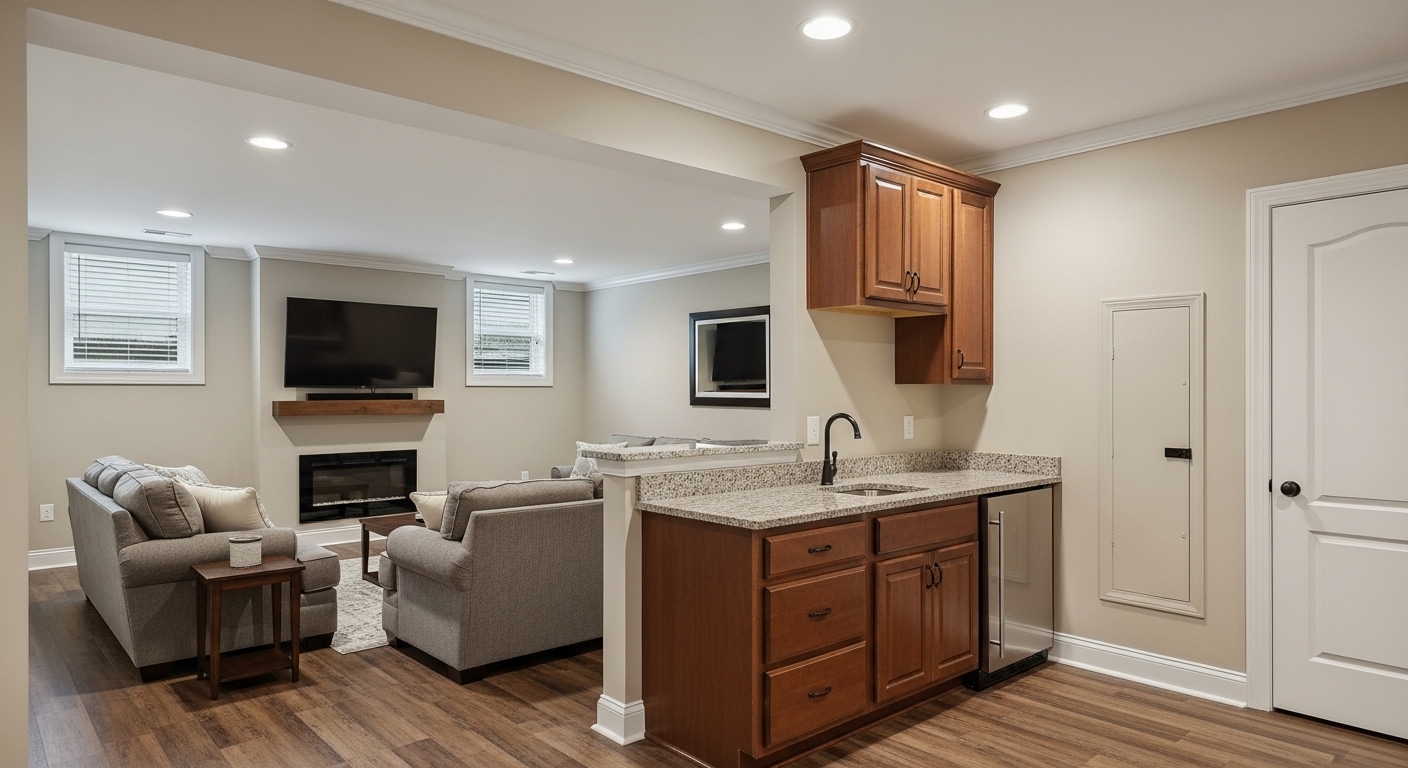
So there you are, standing at the top of the basement stairs, staring down into what is basically a glorified storage unit — maybe some cardboard boxes from two moves ago, a water heater, and a bare concrete floor that echoes every footstep.
And you’re thinking: this could be something.
Maybe it’s a home office. A playroom so the kids stop taking over the living room. A guest suite so your in-laws stop staying in your bedroom. Whatever the vision is, finishing a basement is one of the most satisfying home improvements you can make — but it’s also one where the “what does this actually cost?” question gets really muddy, really fast.
I want to cut through all that muddiness. If you’re a homeowner in Plain Township or the broader Stark County area thinking about a basement project, here’s an honest look at what finishing a basement really involves, what it costs, and what to watch out for.
And hey — if you’re already leaning toward talking to someone local, our Plain Township service page is a good place to start.
The Moment Most Homeowners Realize They Were Thinking About This All Wrong
Here’s a story I hear a lot.
A homeowner spends months on Pinterest. They’ve got a mood board. They know they want shiplap somewhere. They call a few contractors, get a few wildly different numbers, and then… nothing. The project stalls because they don’t know who to trust or what’s actually reasonable.
The problem isn’t that they weren’t motivated. It’s that they started with aesthetics before understanding the mechanics of a basement project. Because finishing a basement isn’t like renovating a kitchen. There are layers — literally — that have to happen in a certain order, with inspections in between, and skipping any of them causes problems down the road.
So let’s talk about what actually goes into this.
What “Finishing a Basement” Actually Means
When contractors talk about a finished basement, they mean transforming an unfinished, open space into livable square footage — insulated walls, a proper ceiling, flooring, electrical, lighting, and usually HVAC.
But here’s the thing most people don’t fully grasp: a finished basement in Ohio has to meet code. That means permits. That means inspections. That means the work has to be done right, not just look right.
In Plain Township and Stark County, you’re going to need a building permit for almost any basement finishing project. It’s not optional, and honestly, it’s not something to resent — those inspections exist to protect you. A finished basement without proper egress windows in sleeping areas, for example, isn’t just a code violation. It’s a genuine safety issue.
The Real Cost Breakdown
Okay, here’s what you actually want to know.
Finishing a basement in the Plain Township area typically runs anywhere from $25 to $60 per square foot, depending on what you’re building and the finishes you choose. For an average 1,000-square-foot basement, that puts the range somewhere between $25,000 and $60,000+.
I know. That’s a big range. Let me explain what moves you toward the lower or upper end.
What Drives Costs Down
- Simple, open layout (one or two rooms, minimal walls)
- Mid-range finishes (LVP flooring, basic trim, standard lighting)
- No bathroom (bathrooms alone can add $5,000–$15,000)
- An already-dry basement with no moisture issues
What Drives Costs Up
- Multiple rooms with dedicated purposes (bedroom, bathroom, office, wet bar)
- High-end finishes (tile, custom cabinetry, recessed lighting throughout)
- Moisture remediation before finishing (this is huge — more on this below)
- Low ceilings that require creative solutions
- Adding an egress window for a legal bedroom
A typical, honest project budget for a nicely-finished basement in this area — one that adds real value and feels like part of your home, not an afterthought — usually lands somewhere between $35,000 and $50,000. That’s not a low-ball number and it’s not a luxury number. It’s the reality for quality work done right.
The Stuff Nobody Warns You About
Here’s where I want to save you some headaches.
Moisture Is Everything
If your basement has any moisture issues — and a lot of Ohio basements do, especially in older homes — you need to deal with that before you finish anything. Full stop.
I’ve seen homeowners skip this step, finish their basement beautifully, and then deal with mold behind the drywall two years later. It’s heartbreaking and expensive. A waterproofing system or proper drainage correction before you build out is non-negotiable.
If you’re not sure whether your basement has moisture problems, here’s a quick test: tape a piece of plastic sheeting to the concrete floor and wall, seal the edges with tape, and leave it for 24-48 hours. If moisture collects on the underside, you’ve got water coming through the concrete. If it’s on top, it’s condensation. Either way, you’ll want to address it.
Ceiling Height Matters More Than You Think
Ohio building code generally requires a minimum ceiling height of 7 feet for finished living space. If your basement is hovering around 6’8″ or 6’10”, you might be cutting it close — especially once you add drywall or a drop ceiling.
This is one of those things worth checking early. Because if the answer is “we need to lower the floor by a few inches,” that’s a very different (and expensive) project.
The Egress Window Question
If you want a legal bedroom in your basement — one that you can list on a real estate listing and that satisfies code — you need an egress window. These are windows large enough for a person to escape through in an emergency.
In Ohio, that means a minimum of 5.7 square feet of opening, with specific height and width requirements. Adding an egress window, which involves cutting through concrete foundation wall and proper well installation, typically runs $2,500–$5,500.
Worth it? Usually yes, especially if you’re thinking about resale.
How the Process Actually Unfolds
If you’re hiring a contractor (and for a project this size, I’d strongly recommend it), here’s a rough order of operations:
1. Planning and Permitting — Your contractor pulls the permit. Don’t let anyone convince you to skip this step or “do it under the radar.” Future you — specifically, future-you-trying-to-sell-the-house — will thank you.
2. Moisture and Waterproofing — Addressed before anything else gets built.
3. Framing — The skeleton of your new rooms goes up. Walls, doorways, soffits to hide ductwork.
4. Rough-In Trades — Electrical, plumbing (if adding a bathroom), and HVAC all happen before any drywall goes up. This is also when you’ll have inspections.
5. Insulation — Basement walls get insulated properly. Spray foam on the rim joists is a game-changer for comfort and energy efficiency.
6. Drywall — The space starts looking like actual rooms.
7. Flooring, Trim, Doors — This is where it starts feeling finished.
8. Final Electrical and Lighting — Outlets, switches, fixtures, recessed lights.
9. Final Inspection and Certificate of Occupancy
The whole process, for a typical basement, takes somewhere between 6 and 12 weeks depending on scope and contractor availability. Longer if there are moisture corrections upfront.
Expert Insights: What Separates a Good Basement From a Great One
Honestly? The things that make a finished basement feel like a real part of your home aren’t usually the expensive ones.
Lighting is huge. Basements don’t get natural light (unless you’ve got walkout), so the lighting plan matters enormously. Recessed cans on dimmers, under-cabinet lighting, maybe a statement fixture in a gathering area — these details transform how a space feels.
Insulation choices affect everything. Rigid foam insulation on basement walls outperforms standard fiberglass batts for moisture resistance and comfort. Yes, it costs a bit more. Yes, it’s worth it in Ohio winters.
Don’t cheap out on flooring. Basements are susceptible to moisture, so solid hardwood is generally a bad choice. Luxury vinyl plank (LVP) has gotten remarkably good and handles the moisture environment well. Tile is great for bathrooms and utility areas. Carpet is cozy but only if moisture is fully controlled.
Think about sound. If this is becoming a home theater, a bedroom, or a playroom where kids will be loud, consider acoustic insulation between the ceiling drywall and the floor above. It’s not expensive to add during construction and it’s very expensive to add after the fact.
Frequently Asked Questions
How long does a basement finishing project take in Plain Township? Most projects run 6–12 weeks from permit approval to final inspection. Add 2–4 weeks if moisture remediation is needed first.
Do I need a permit to finish my basement in Stark County? Yes. Any finished basement that adds living space requires a building permit. Your contractor should handle this — if they suggest skipping it, that’s a red flag.
What’s the ROI on a finished basement? It varies, but most sources suggest you recoup 60–75% of your investment at resale. More importantly, you get to enjoy that space for years before you sell. It’s one of the best cost-per-square-foot ways to add usable space to your home.
Can I add a bathroom to my basement? Yes, but it requires a sewage ejector pump system if your sewer line runs above the basement floor level (common in Ohio). Budget an additional $5,000–$12,000 for a basic bathroom, more for a full bath with tile and custom finishes.
How do I find a good contractor for basement finishing near Plain Township? Look for licensed, insured contractors with local references. Ask to see completed basement projects specifically — not just general remodeling work. And get at least three quotes, but don’t automatically take the lowest one. Understand what’s included in each bid before comparing numbers.
The Bottom Line
A finished basement is one of the most rewarding projects you can do to a home. You’re not just adding value on paper — you’re adding actual space your family uses every day.
But it’s also a project where cutting corners early creates problems later. Moisture issues, skipped permits, under-insulated walls — these all come back to bite you. The homeowners who end up happiest with their finished basements are the ones who went in with realistic expectations, chose contractors they actually trusted, and didn’t try to squeeze every dollar out of the budget at the cost of quality.
If you’re in Plain Township and starting to think seriously about this, we’d love to talk through your project. Not a hard sell — just a real conversation about what your basement could become and what it would actually take to get there.
Because that space at the bottom of your stairs? It can be something really great.