
Let’s Talk About That Old Building of Yours
You know that feeling when you walk into a space and it just feels… tired? Maybe the floors are scuffed, the layout feels like a maze from the 1980s, or the “vintage” charm has officially crossed the line into “dilapidated.” We’ve all been there.
When you’re looking at a commercial property, whether it’s a storefront in Canton or an old warehouse in Cleveland, the big question eventually hits: Do we renovate this thing or restore it?
People tend to use those words like they’re the same thing, but honestly? They’re worlds apart. Choosing the wrong path can be the difference between a project that pays for itself and a money pit that keeps you up at night.
I’ve seen folks jump into a “restoration” only to realize halfway through that they actually just wanted a modern office with better lighting. Conversely, I’ve seen people “renovate” a historic gem and accidentally strip away all the value that made it special in the first place.
So, let’s grab a coffee and break down what’s actually happening behind the drywall. If you’re feeling overwhelmed, don’t sweat it—you can always reach out to us to walk through your specific site.
1. Renovation: The Fresh Start
Renovation is basically giving a building a “new life.” When you renovate, you’re updating the old to meet modern standards. You’re painting, installing new flooring, maybe knocking down a wall to create that open-concept vibe everyone loves. It’s about utility and aesthetics.
The goal here isn’t necessarily to honor the past; it’s to make the space work for right now. If you bought an old retail space and want to turn it into a high-end tech hub with LED strips and polished concrete, you’re looking at a commercial renovation.
Real-World Scenario: Imagine an old doctor’s office in Akron. It has tiny rooms and beige wallpaper. A renovation would involve ripping out those walls to create a large coworking space, installing USB-C outlets everywhere, and putting in a modern kitchenette.
Pro Tip: Renovations usually offer the best ROI because you’re focusing on what modern tenants actually want to pay for.
2. Restoration: Honoring the History
Restoration is a completely different beast. This is for the soul of the building. When you restore a property, you’re trying to bring it back to a specific point in time—usually when it was first built. You aren’t looking for “new”; you’re looking for “original.”
This involves a lot of detective work. You’re stripping away layers of bad 70s paint to find the original wood grain. You’re sourcing matching limestone for the facade. It’s meticulous, and yeah, it’s usually more expensive because you can’t just buy the materials at a big-box store.
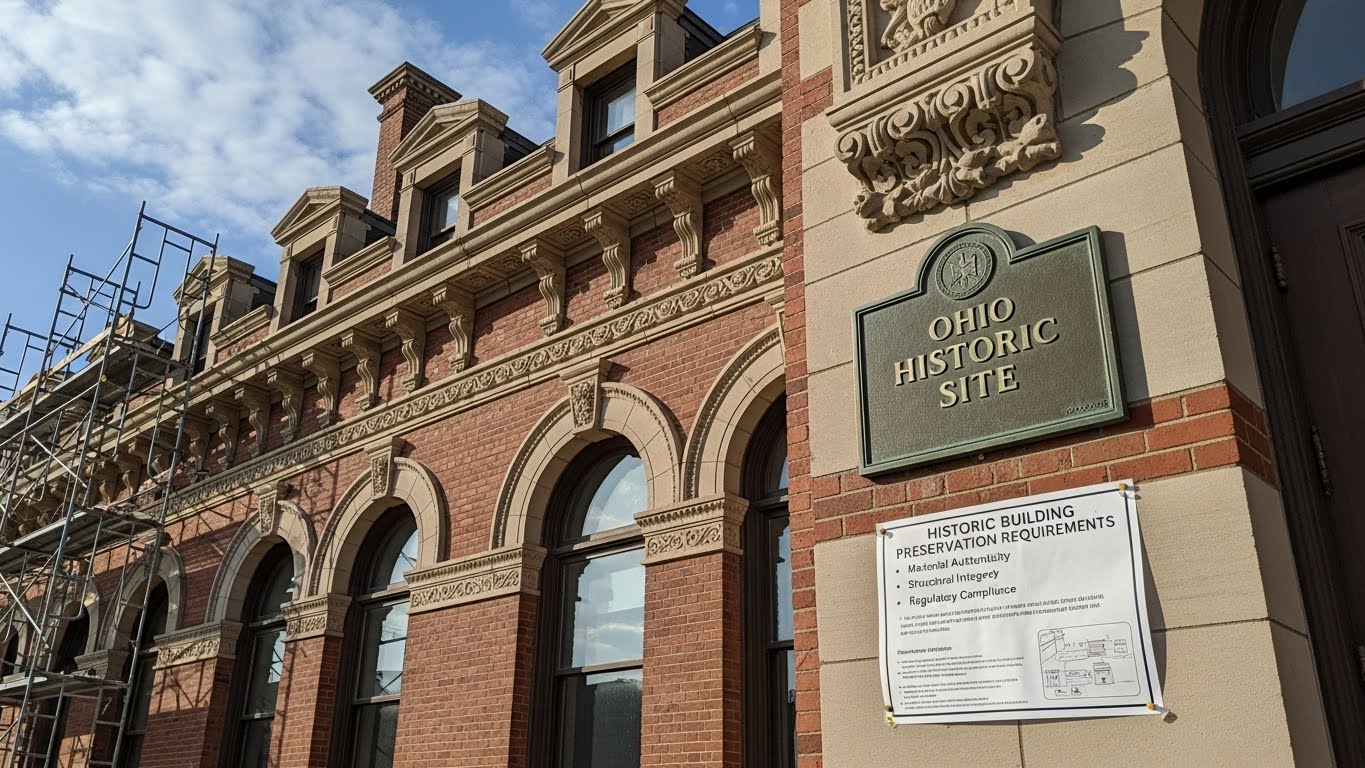
Real-World Scenario: Think about those beautiful historic buildings in Ohio. If you have a 1920s bank with original crown molding and marble floors, you don’t “renovate” that into a neon-colored gym. You restore the marble, fix the original windows, and keep the grandeur intact.
Pro Tip: Check if your building is on a historic register. If it is, you might be required to restore rather than renovate, but there are often tax credits to help with the bill.
3. The “Why” Behind the Choice
Before you swing a hammer, you have to ask: What is this building’s job? If the building is just a vessel for your business—like a warehouse or a standard office—renovation is your friend. It’s fast, it’s efficient, and it’s predictable.
But if the building is the brand—like a boutique hotel or a flagship restaurant—restoration adds a level of prestige you just can’t manufacture with new materials. People pay a premium for “authentic.”
Real-World Scenario: A client in Massillon once asked if they should modernize an old storefront. We looked at the original brickwork hidden behind siding. By restoring the brick instead of just putting up new drywall, they created a “vibe” that attracted a high-end coffee shop as a tenant.
Pro Tip: Don’t fight the building. If it has “good bones” and character, lean into it. If it’s a generic concrete box, go full modern.
4. The Budget Reality Check
Let’s be real for a second: money talks. Renovations are generally easier to budget for because the materials are standard. You know what a square foot of LVP flooring costs.
Restoration is where the “surprises” live. You might find out the original wiring is wrapped in cloth (yikes) or that the specific type of oak used in 1890 is now extinct. You need a contingency fund that’s a bit beefier for restoration projects.
Real-World Scenario: I’ve seen “simple” restorations double in cost because the masonry was more far gone than it looked. On the flip side, a bathroom remodeling project in a commercial space is usually pretty straightforward to quote.
Pro Tip: Always get a structural assessment before committing to a restoration. What’s under the surface matters more than the “pretty” stuff.
5. Codes and Compliance (The Boring but Vital Part)
Whether you renovate or restore, the city of Parma or Canton is going to have thoughts. Modern building codes, especially ADA compliance, don’t care how “historic” your building is.
If you’re restoring, you have to find clever ways to hide modern HVAC or elevators without ruining the look. If you’re renovating, you’re usually stripping things down to the studs anyway, so meeting code is often a bit simpler.
Real-World Scenario: We once worked on a project where we had to install a wheelchair ramp in a 100-year-old building. A “renovation” approach would have just bolted metal to the front. A “restoration” approach meant using matching stone to make the ramp look like it was always part of the original design.
Pro Tip: Hire a contractor who actually understands local Ohio codes. It saves you months of permit headaches.
Renovation vs. Restoration: A Quick Look
| Feature | Renovation | Restoration |
| Primary Goal | Modernization & Function | Historical Accuracy |
| Materials | Modern/New | Period-Correct/Original |
| Cost | Generally Lower/Predictable | Generally Higher/Variable |
| Timeline | Faster | Slower/Detail-Oriented |
| Best For | ROI, Offices, Retail | Landmarks, Boutique Spaces |
The Big Takeaways
- Renovation is about the future (making the space work for today’s needs).
- Restoration is about the past (protecting the heritage of the structure).
- Renovations are usually better for standard business operations and tight budgets.
- Restorations can qualify for significant tax credits and create a unique “brand” for the property.
- Location matters. Regulations in Stark County might differ slightly from Cuyahoga County, especially regarding historic districts.
Ready to Start Digging?
Look, at the end of the day, your building is an investment. Whether you want to rip it all out and start over or lovingly bring back its former glory, you need a team that knows the difference between “old” and “historic.”
If you’re sitting on a property in Northeast Ohio and your head is spinning with possibilities, let’s chat. We’ve seen it all—from the “oh no, what is that behind the wall?” moments to the “wow, I can’t believe this is the same building” finishes.
Would you like me to put together a preliminary checklist for your specific property type, or perhaps help you find out if your building is in a designated historic zone? Drop us a line and let’s get to work.