
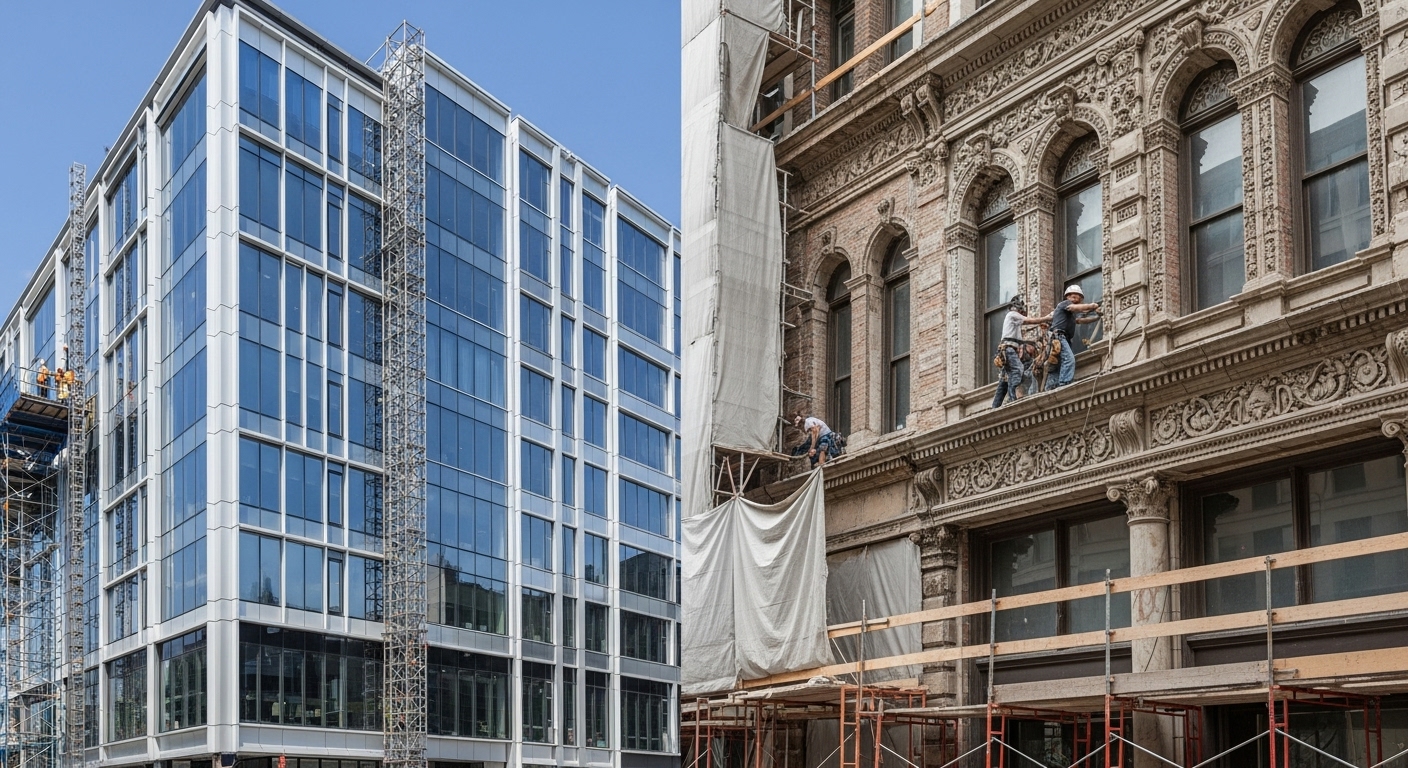
The “Soul” of a Building: Why the Choice Matters
Have you ever walked past one of those old brick buildings in downtown Canton or Cleveland and just felt… something? Maybe it’s the way the sunlight hits the original masonry or the giant, hand-carved doors. It has a story. But then you look closer and notice the windows are drafty, the layout is a maze, and the Wi-Fi signal probably goes to die in those thick walls.
Now, compare that to a sleek, modern office space with glass partitions and an open floor plan. It’s efficient. It’s bright. It works.
When you’re looking at a commercial property, you eventually hit a fork in the road. Do you keep that old soul alive, or do you tear it down to the studs and start over? Honestly, this isn’t just a “construction” question. It’s a business decision. Choosing between commercial building renovation vs. restoration determines your budget, your timeline, and ultimately, the “vibe” your business projects to the world.
If you’re already leaning toward one way but aren’t sure if the bones of your building can handle it, you might want to look into commercial renovation vs. restoration in a bit more detail. But for now, let’s sit down and figure out which path makes sense for your goals.
Overview of the Options
Before we dive into the nitty-gritty, let’s make sure we’re talking about the same thing. People use these words interchangeably, but in the world of hardhats and blue prints, they’re worlds apart.
- Renovation: This is about “out with the old, in with the new.” You’re updating, refreshing, and making things modern. It’s the “new kitchen” of the commercial world.
- Restoration: This is about “turning back the clock.” You’re trying to return the building to its original glory, using historically accurate materials whenever possible.
- Rehabilitation: This is the middle ground. You keep the historical character but upgrade the “guts” (like the HVAC and electrical) so people can actually work there without freezing.
Detailed Comparison: Breaking it Down
1. Commercial Renovation: The Modern Makeover
Renovation is usually what people mean when they say they want to “fix up” a space. You’re taking an existing structure and changing its appearance or function.
- Key Features: New flooring, knocking down walls to create open offices, installing modern LED lighting, and upgrading to high-speed tech infrastructure.
- Pros: It’s usually faster than restoration. You have total creative freedom. You can prioritize efficiency and current building codes without worrying about “authenticity.”
- Cons: You might lose the “character” that made the building unique. In older Ohio cities, if you renovate a historic building too aggressively, you might actually lower its market value.
- Best Use Case: Retail spaces that need to follow brand guidelines, medical offices, or tech startups that need “clean” environments.
2. Commercial Restoration: The Time Machine
Restoration is a labor of love. You aren’t just fixing it; you’re preserving it.
- Key Features: Stripping away 50 years of bad paint to find the original wood, sourcing period-accurate hardware, and repairing historic masonry restoration in Canton using traditional techniques.
- Pros: Incredible prestige and “curb appeal.” These buildings stand out. You may also be eligible for significant federal or state tax credits for historic preservation.
- Cons: It’s almost always more expensive. Finding materials (like specific types of slate or old-growth wood) can take months. You’re often limited by what you can’t change.
- Best Use Case: Museums, law firms in “stately” buildings, boutique hotels, or landmarks.
3. Rehabilitation: The Hybrid (Best of Both Worlds)
Honestly, this is where most of my clients end up. You want the brick walls and the high ceilings, but you also want a commercial building restoration in Canton that doesn’t feel like a dusty museum.
- Key Features: Preserving the facade and key architectural details while gutting the electrical and plumbing.
- Pros: High ROI. You get the “cool” factor of an old building with the reliability of a new one.
- Cons: Balancing “new” and “old” is tricky. You might find “surprises” behind the walls that neither a standard renovation nor a pure restoration would have prepared you for.
- Best Use Case: Trendy restaurants, loft-style offices, and “Main Street” small businesses.
Side-by-Side Comparison
| Factor | Renovation | Restoration | Rehabilitation (Hybrid) |
| Primary Goal | Modernize & Function | Historical Accuracy | Preserve Character + Utility |
| Average Cost | Moderate to High | Very High | Moderate/High |
| Speed | Fast(er) | Slow | Moderate |
| Flexibility | High | Very Low | Moderate |
| Tax Credits? | Rarely | Often | Sometimes |
Expert Recommendations: Which One for You?
Look, I’ve been on enough job sites to tell you that the building usually tells you what it wants to be. But if you’re undecided, here’s my “gut check” list:
Choose Renovation if… You’re in a building built after 1980 that has no real architectural significance. If it’s a “beige box,” don’t try to make it a landmark. Make it the most efficient, beautiful beige box it can be. If you’re looking at a business renovation in Akron, this is often the most practical path.
Choose Restoration if… The building is on the National Register of Historic Places or has features that literally cannot be replaced today (like hand-carved stone or rare stained glass). If you have the budget and the patience, these projects become the crown jewels of a city.
Choose Rehabilitation if… You have a building with “good bones” and a great story, but you need it to be a high-performance workspace. This is the most common path for historic building preservation in Ohio.
Decision Framework: 5 Questions to Ask Your Team
Before you sign a contract, get your stakeholders in a room and ask these:
- What is the building’s “highest and best use”? Does a tech firm need a 100-year-old marble floor?
- What does the local zoning/historic board say? In many Ohio towns, if you’re in a historic district, “restoration” might be your only legal option.
- Are there tax incentives? Sometimes the tax credit for restoration covers the extra cost of the fancy materials.
- How long can we afford to be “closed”? Renovation gets you open sooner.
- What is our brand identity? Are you “cutting edge” (Renovate) or “timeless and trusted” (Restore)?
Commercial Renovation vs Restoration: Detailed Cost Comparison
Is restoration always more expensive?
Almost always. Sourcing specialized craftsmen who know how to do historic masonry restoration or old-school carpentry costs more than standard labor.
Can I do a “modern” interior in a restored exterior?
Yes! This is actually the definition of rehabilitation. It’s a very popular way to save a building while making it profitable.
How do I know if my building is “historic”?
Check with the Ohio History Connection or your local county auditor. Just because it’s old doesn’t mean it’s “designated historic,” but it might still have architectural value.
Wrapping It Up: Your Building’s Next Chapter
At the end of the day, your building is a tool. It needs to work for your business. But here in Ohio, we’re lucky to have so many structures that are more than just four walls and a roof. They’re part of our heritage.
Whether you decide to go with a full-blown commercial building renovation to maximize efficiency or a meticulous restoration to honor the past, the most important step is starting with a team that knows the difference. You don’t want someone taking a sledgehammer to a piece of history because they didn’t know what they were looking at.
If you’re staring at an old space and wondering where to start, we’d love to help you walk through the options. We’ve handled everything from simple office space remodeling in Cuyahoga to complex restorations. Let’s find the soul of your building and make sure it has a future.
[Contact K&K Construction today for a commercial property assessment!]
Would you like me to look up the specific historic district guidelines for your street address so we can see if you’re eligible for any state preservation tax credits?