
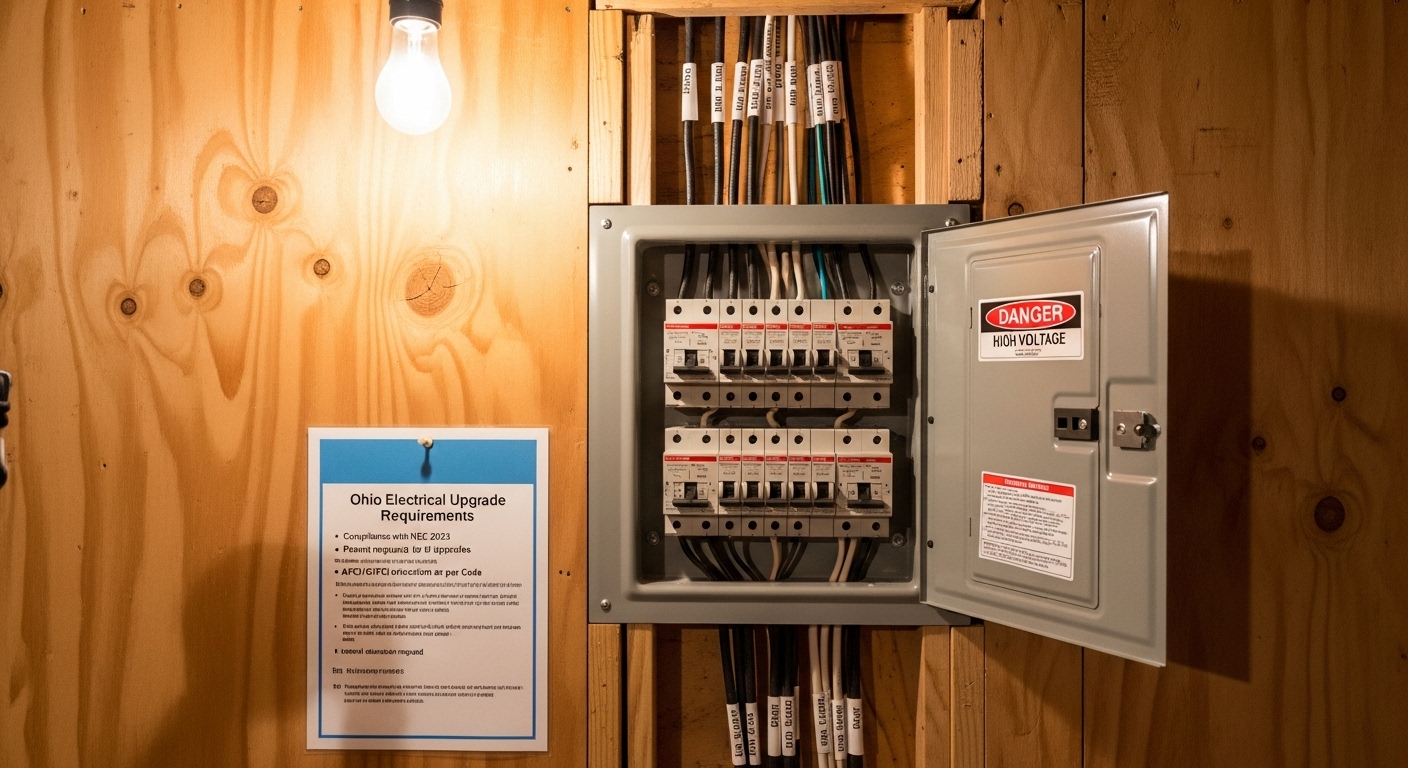
The Heartbeat of Your Home is Behind a Little Metal Door
Have you ever stopped to think about that gray metal box tucked away in your basement or garage? You probably only notice it when a hair dryer and a space heater decide to run at the same time and—click—everything goes dark. Honestly, most of us treat our electrical panels like that one relative we only talk to when we need a favor.
But here’s the thing: our homes in Ohio weren’t exactly built for the way we live today. Think about it. When many of our beautiful homes in places like Canton or Akron were built, the biggest “tech” in the house was a color TV and a toaster. Now? We’ve got EVs in the garage, air fryers on the counter, and everyone in the house has three devices plugged in at once.
If you’re noticing your lights flickering when the AC kicks on, or if you’re still looking at a “Zinsco” or “Federal Pacific” label, we need to have a real talk. Upgrading isn’t just about avoiding a tripped breaker; it’s about making sure your house doesn’t become a safety statistic.
I want to walk you through what an Electrical Panel Upgrade in Ohio actually looks like for a homeowner. It’s not as scary as it sounds, but there are a few things you absolutely need to know to stay on the right side of the code and the safe side of the bed.
1. Recognizing the “Dinosaur” Panels
First off, let’s talk about the brands that make electricians break out in a cold sweat. If you open your panel and see names like Federal Pacific (FPE) or Zinsco, look… you’ve got a problem. These are notorious for failing to trip when they should. Instead of cutting the power, they just melt.
And then there are the old-school fuse boxes. While they aren’t inherently “evil,” they’re usually capped at 60 or 100 amps. That’s just not enough juice for a modern lifestyle. If you find yourself hunting for those little glass screw-in fuses at the hardware store, you’re definitely overdue for a change.
A Real-World Scenario: I once helped a homeowner in Massillon who was getting ready for a kitchen remodeling project. We opened the panel and found an old FPE box that looked fine on the outside, but the bus bar on the inside was actually charred. They had no idea they were a hair’s breadth away from a house fire just by running their dishwasher.
Pro Tip: Take a flashlight and look for signs of “pitting” or discoloration on the breakers. If it looks toasted, it probably is.
2. The 200-Amp Standard
In the world of Electrical Panel Upgrade Requirements in Ohio, 200 amps is the “Goldilocks” zone. Most older homes were set up with 100-amp service. Back in the day, that was plenty. But today? Between the central air, the electric dryer, and the high-efficiency furnace, you’re redlining that 100-amp system.
Upgrading to 200 amps gives your home “room to breathe.” It means you can add that hot tub or finally finish the basement remodeling project without worrying about the lights dimming every time the fridge cycles on. It’s basically like widening a one-lane road into a four-lane highway.
Quick Insight: If you’re planning on getting an Electric Vehicle (EV) anytime soon, don’t even bother with 100 amps. You’ll need that 200-amp service just to charge the car and keep the lights on simultaneously.
3. AFCI and GFCI Code Requirements
This is where things get a bit “techy,” but stay with me. Ohio follows the National Electrical Code (NEC), and they’ve gotten really strict lately—for good reason. Arc-Fault Circuit Interrupters (AFCI) are now required for almost every room in the house during an upgrade.
AFCI breakers are smart. They can “hear” the difference between a normal spark (like a switch turning on) and a dangerous arc (like a nail through a wire in the wall). They shut things down before a fire starts. When you do an electrical panel upgrade in Ohio, you can’t just put in the cheap old breakers; you have to meet these new safety standards.
A Real-World Scenario: A client was doing a residential rehabilitation in Cuyahoga County and was frustrated that the “new breakers” kept tripping. Turns out, the AFCI was doing its job—it found a frayed wire behind a bedroom wall that had been there for twenty years. It saved their house.
Pro Tip: AFCI breakers are more expensive than standard ones. When you get a quote, if the price seems too low, they might be skipping these required safety features. Don’t let them.
4. Grounding and Bonding (The Invisible Safety)
This is the least “sexy” part of an upgrade, but it’s the most vital. Your panel needs a clear path for excess electricity to go into the dirt, rather than into you. Ohio requirements usually involve two grounding rods driven eight feet into the ground outside your home.
We also have to “bond” your water pipes and gas lines. This ensures that if a wire ever touches a pipe, the breaker trips immediately instead of turning your kitchen sink into a live wire. In our older Ohio neighborhoods, grounding is often corroded or non-existent.
A Real-World Scenario: Think about that tingle you sometimes feel when you touch a metal appliance. That’s not “static”—that’s a grounding issue. I’ve seen homes where the ground wire was just tied to a rusty old pipe that didn’t even go into the earth anymore.
Quick Insight: During a professional upgrade, an inspector will check your grounding rods. If they aren’t there, you won’t pass.
5. Labeling and Clearance Space
Believe it or not, the “clutter” around your panel is a code issue. In Ohio, you need a “working space” that is 30 inches wide, 36 inches deep, and 6.5 feet high in front of the panel. You can’t have your holiday decorations or a stack of tires blocking it.
Also, every single breaker must be clearly and permanently labeled. “Lights” isn’t enough. It needs to be “Master Bedroom Lights/Outlets.” If there’s an emergency, you don’t want to be playing “guess the switch” while smoke is in the air.
Pro Tip: If you’re doing a bathroom remodeling project, make sure your electrician updates the panel labels immediately. It’s a small detail that makes a huge difference later.
At-A-Glance: Old vs. New
| Feature | Old System (Pre-1990) | Modern Ohio Standard |
| Capacity | 60 – 100 Amps | 200 Amps |
| Breaker Type | Standard Thermal | AFCI / GFCI Hybrid |
| Grounding | Single rod (or none) | Dual 8-foot rods + Bonding |
| Safety | Fire risk with FPE/Zinsco | Advanced Arc-Fault detection |
| Future-Proof | Barely handles a microwave | Ready for EV chargers & Solar |
The “Must-Do” Takeaways for Ohio Homeowners
I know, it’s a lot to take in. But if you walk away with nothing else, remember these three things:
- Safety over Savings: Don’t let a “handyman” swap your panel for a case of beer. This requires a permit and an inspection from the city or county. If something goes wrong and you don’t have a permit, your insurance company might walk away from the claim.
- Check the Brands: If your panel says Federal Pacific, Zinsco, or Sylvania, stop reading and call a pro. Seriously. Those things are ticking time bombs.
- Plan for the Future: Even if you think you don’t need 200 amps now, you will eventually. It adds significant value to your home when you go to sell.
Let’s Keep the Lights On (Safely)
Look, I get it. An electrical panel isn’t as “fun” to spend money on as a new deck or a fancy kitchen. But it’s the foundation of everything else you do in your home. It’s the difference between sleeping soundly and jumping every time you hear a pop in the walls.
If you’re worried about your home’s wiring, or if you’re planning a big project like a residential rehabilitation in Massillon, let’s make sure your power is up to the task. At K&K Construction, we’ve seen it all—from “bird’s nest” wiring to panels that haven’t been touched since the 50s.
We’d be happy to take a look at your system and give you an honest take on what you actually need. No jargon, no pressure—just making sure your Ohio home is safe for the long haul.
Contact us today for an electrical safety assessment!
Would you like me to look up the specific permit costs for your local Ohio county to give you a better idea of the total budget?