
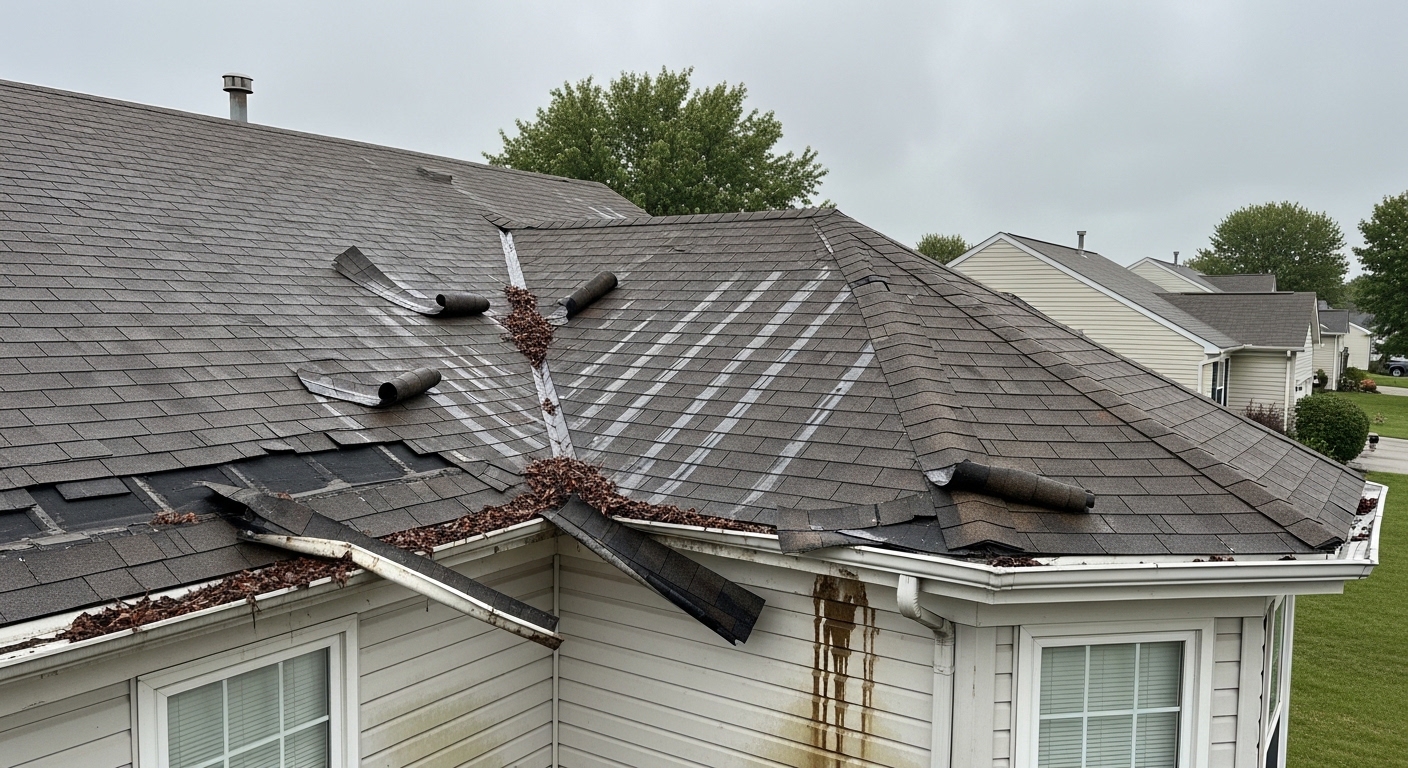
You know that sick feeling. You’re sitting in your living room, it’s raining outside, and you hear it — that faint drip. Or maybe you’re cleaning gutters and you pull out a handful of gritty black stuff that used to be your shingles. Or you spot that dark stain spreading across your ceiling like a slow-moving storm.
If you own a home in Plain Township, you’ve probably already had one of those moments. And if you haven’t yet — well, you might want to keep reading.
Ohio weather is genuinely brutal on roofs. We’re talking freeze-thaw cycles that pry at seams, summer heat that bakes shingles until they curl, and storm seasons that test every flashing and fastener. Plain Township homes deal with all of it, and the roofing issues that show up around here follow pretty predictable patterns once you know what to look for.
So let’s walk through the most common ones. Not in a scary, doom-and-gloom way — but in the way a knowledgeable neighbor might sit down with you and say, “Here’s what I’d watch out for.” If you’ve got questions specific to your home, the team at K&K Construction serves Plain Township and surrounding Stark County communities and they’re worth a call.
The Most Common Roofing Issues for Plain Township Homes
1. Ice Dams — Ohio’s Sneaky Winter Villain
If you’ve ever noticed thick ridges of ice forming along your roof’s edge in January, that’s an ice dam. Here’s what’s actually happening: heat from inside your home rises, warms the roof deck, and melts the snow on top. That water runs down toward the cold eaves, refreezes, and builds up a wall of ice.
Behind that wall? Trapped meltwater with nowhere to go — except under your shingles. And once water gets under shingles, you’ve got a leaking problem that shows up inside your home, usually right when you least want it.
The real fix isn’t just better gutters or roof rakes (though those help short-term). It’s about attic insulation and ventilation — keeping the roof deck cold so the snow doesn’t melt unevenly in the first place. If you’re seeing ice dams more than once every few winters, it’s worth having someone look at what’s happening in your attic.
Quick tip: Never try to chip away ice dams yourself. You’ll damage the shingles. A roof rake from the ground, or calling a pro, is the safer move.
2. Shingle Granule Loss — The Aging Clock Is Ticking
Those black specks piling up in your gutters or downspout splash blocks? That’s granule loss, and it’s one of the clearest signs that your shingles are aging out.
Asphalt shingles have a layer of mineral granules embedded on the surface. They protect the underlying asphalt from UV rays and give shingles their texture and color. Over time — especially after Ohio’s long, sunny summers — those granules loosen and wash away. Once they’re gone, the asphalt beneath degrades much faster.
A little granule loss is normal on a roof that’s 15+ years old. A lot of it, especially if you’re finding whole patches of bare, shiny shingles, means you’re probably closer to replacement than repair.
Quick tip: Check your gutters every spring. A small amount of grit is fine. Handfuls of it after every rain is a red flag.
3. Flashing Failures — The Most Overlooked Leak Source
Flashing is the metal that seals all the transitions on your roof — where the roof meets the chimney, skylights, vents, valleys, and walls. It’s not glamorous, and most homeowners don’t even know the word “flashing” until something goes wrong.
But here’s the thing: flashing is responsible for more roof leaks than failed shingles. When flashing rusts, separates, or was installed incorrectly in the first place, water finds the gap. And because it’s often in a weird corner or hidden spot, leaks from bad flashing can be hard to trace back to the source.
Plain Township homes with chimneys are especially vulnerable. The step flashing and counter flashing around a chimney has to handle a lot — expansion, contraction, ice, water — and even good flashing has a lifespan.
Quick tip: If you have a roof leak near any transition point (chimney, skylight, wall), suspect the flashing first.
4. Poor Attic Ventilation — The Hidden Damage Multiplier
This one surprises people. You might think of ventilation as a comfort thing — keeping your attic from turning into a sauna in summer. And it does that. But ventilation is also critical for roof longevity.
Without proper airflow, heat and moisture get trapped in your attic. In winter, that trapped moisture condenses, soaks into the wood sheathing, and eventually causes rot and mold. In summer, the heat buildup literally cooks your shingles from below, shortening their lifespan by years.
A lot of Plain Township homes — especially older ones — are under-ventilated. It’s not always obvious until you’re looking at premature shingle failure or a musty attic.
Quick tip: A well-ventilated attic should feel only slightly warmer than outside in summer, not like an oven. If you can only stand to be up there for 30 seconds in July, that’s a sign.
5. Storm Damage — More Subtle Than You Think
We get some serious storms here. Hail, high winds, tree limb strikes — and Ohio’s spring storm season is no joke. The obvious damage is easy to spot. A branch through your roof. Missing shingles you can see from the street.
But storm damage is often subtle. A hailstorm can leave small impact marks on shingles that look fine from the ground but have actually fractured the granule layer and weakened the mat underneath. Wind can lift shingle edges just enough to break the seal strip — you won’t see it, but water will find its way in eventually.
After any significant storm, it’s worth a careful look — or a call to someone who does this professionally. Many homeowners don’t realize storm damage exists until water is already showing up inside.
Quick tip: Keep a record of storm dates. If you do end up needing an insurance claim, documentation of when storms hit your area is helpful.
6. Clogged or Damaged Gutters — The Underrated Roof Enemy
Gutters don’t get enough credit. They’re basically your roof’s drainage system, and when they fail, the consequences travel up.
Clogged gutters cause water to back up and sit against your fascia boards, eventually rotting them out. They contribute to ice dam formation in winter. They allow water to pool against your foundation. And if the gutters themselves are pulling away from the house — from ice weight, or just age — the fascia behind them is usually already damaged.
Plain Township gets plenty of leaves, seeds, and debris from surrounding trees. Cleaning gutters twice a year (spring and fall) is honestly just good homeownership here.
Quick tip: Look for gutters that sag in the middle or pull away at the corners. Those aren’t just cosmetic problems — they mean water isn’t draining where it should.
7. Roof Decking Issues — When the Problem Goes Deeper
Underneath your shingles is a layer of plywood or OSB called the roof deck (or decking). It’s the structural foundation everything else sits on. And when it gets wet — from a long-term slow leak, from ice dam damage, from ventilation problems — it can rot or delaminate.
You might notice soft spots if you ever walk on the roof. Or you might not notice at all until a roofer tears off old shingles and discovers sections that need to be replaced. Either way, decking damage adds to replacement cost, so catching moisture problems early is worth it.
Quick tip: During any roof replacement, ask whether the contractor is pricing for decking replacement. If they’re not even looking at it, that’s worth noting.
8. Aging Caulk and Sealants — Small Cracks, Big Problems
Around vent pipes, skylights, and other roof penetrations, caulk and sealants do the final sealing work. They’re flexible, they’re effective — and they don’t last forever.
Caulk dries out, cracks, and pulls away over time. In Ohio’s climate, the repeated freeze-thaw cycles accelerate that process. It’s one of those things that’s cheap to fix proactively and expensive to deal with reactively, because once water gets into a penetration, it tracks down in unpredictable ways.
Quick tip: If your roof is over 10 years old, a good inspection should include a close look at all penetrations and their sealants.
Quick Reference: Common Issues at a Glance
| Issue | Warning Signs | DIY or Pro? |
| Ice Dams | Ice ridges at eaves, ceiling stains | Pro (fix insulation/ventilation) |
| Granule Loss | Grit in gutters, bare shingle patches | Pro if widespread |
| Flashing Failures | Leaks near chimney/skylights | Pro |
| Poor Ventilation | Hot attic, early shingle wear | Pro assessment |
| Storm Damage | Impact marks, lifted shingles | Pro inspection |
| Clogged Gutters | Sagging gutters, water overflow | DIY (clean) / Pro (repair) |
| Decking Issues | Soft spots, interior rot smell | Pro |
| Failed Sealants | Cracked caulk at penetrations | DIY or Pro |
Key Takeaways
Here’s what I’d want you to walk away remembering:
- Ohio’s freeze-thaw cycles and storms make roofs work harder here than in a lot of other climates — regular inspections matter.
- A lot of roofing problems start small and hidden. By the time you see a stain on your ceiling, something’s been going wrong for a while.
- Ventilation and insulation aren’t just energy concerns — they directly affect how long your roof lasts.
- Gutters are part of your roofing system. Don’t treat them as an afterthought.
- Most of these issues are cheaper to address early. A $300 flashing repair beats a $15,000 roof replacement that could have waited five more years.
So What Do You Do Next?
Honestly? The best thing most Plain Township homeowners can do is get eyes on their roof at least once a year — and after any significant storm. You don’t have to know what you’re looking at. That’s what professionals are for.
If your roof is over 15 years old, or you’ve had any of the warning signs above, it’s worth getting a professional assessment before small issues compound into big ones. K&K Construction works with homeowners in Plain Township and throughout Stark County — they can tell you honestly what you’re dealing with and what it’ll take to fix it.
Roofing isn’t the most exciting part of homeownership. But catching problems early? That’s the kind of thing that saves you thousands of dollars and a lot of stress. And around here, with Ohio weather being what it is, that’s worth paying attention to.
Take care of your roof, and it’ll take care of you.